

About this fungus
Aborted Entoloma is a fungus in the Entolomataceae family. Its habitat and field characteristics are summarised below.
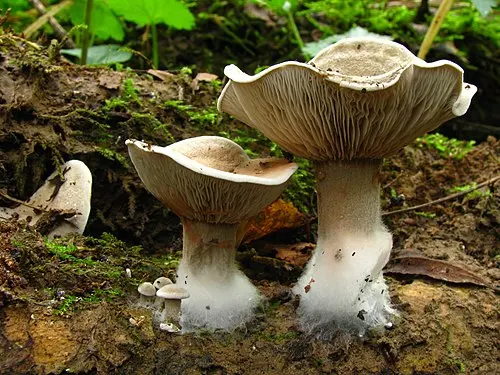
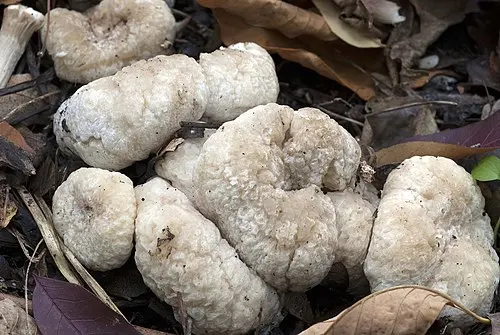
This eastern North American species appears as a normal grey, pink-spored Entoloma near decaying hardwood and often beside pale, lumpy growths called carpophoroids. Despite the historical common name, those lumps are malformed Armillaria fruit bodies invaded by Entoloma abortivum, not aborted versions of the Entoloma mushroom.
What to check
The normal form has a 2 to 8 cm grey to grey-brown cap, initially convex with an inrolled edge and later broadly convex or flat. Its crowded pale-grey gills become pink as spores mature and are attached to the stem or begin to run down it. The solid pale stem has white basal mycelium but no ring or volva, and the odour is strongly mealy. Nearby carpophoroids are irregular whitish masses, often browning with age and showing white and pinkish areas inside. Their presence supports the interaction, but the normal mushroom still requires the usual Entoloma characters.
Variation
Normal fruit bodies range from pale grey to grey-brown and may have a central bump. Carpophoroids vary greatly in outline and size because they are distorted Armillaria fruit bodies containing tissues from both fungi. Normal Entoloma, normal Armillaria and malformed masses can occur in the same patch in different proportions.
Lookalikes
The normal gilled mushroom can resemble other grey or brown pink-spored Entoloma, including poisonous species, and often cannot be named securely from photographs alone. Clitopilus species may also have decurrent gills and pink spores but differ microscopically. Pale lumpy growths can be confused with other malformed fungi, puffballs or animal remains, so their internal structure and association with normal fruit bodies matter.
Habitat and range
Entoloma abortivum parasitises developing Armillaria fruit bodies and probably also lives saprobically in woody debris and leaf litter. It grows near decaying wood in hardwood or mixed forests, usually in late summer and autumn. The well-supported range is eastern North America, especially east of the Rocky Mountains.
Food safety
Edibility is uncertain or disputed.
Photographs
 Dan Molter / CC BY-SA 3.0
 Dr Lorne Stobbs / CC BY-SA 3.0