
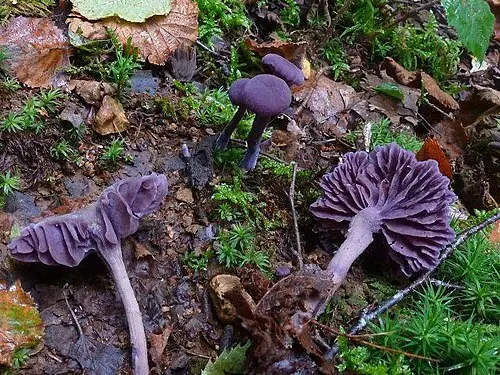
About this fungus
Amethyst Deceiver is a fungus in the Hydnangiaceae family. Its habitat and field characteristics are summarised below.
A small woodland mushroom that can be deep amethyst-purple when fresh. Its thick, widely spaced gills usually hold their colour longer than the cap, while the slender stem is fibrous and has no ring.
What to check
Look for thick, widely spaced violet gills, a tough fibrous stem and a white spore print. These features matter more than cap colour alone. There is no cobweb-like veil and no rusty-brown spore deposit.
Variation
Moist young mushrooms can be intensely violet. As they dry or age, the cap fades through lilac to pale buff and may become finely scaly, making old specimens much less distinctive. The gills and upper stem often retain some violet after the cap has faded.
Lookalikes
Purple Cortinarius species can have a cobweb-like veil when young and develop rusty-brown gills and spores. Purple forms of Mycena pura are more fragile and have a radish-like odour. The Common Deceiver, Laccaria laccata, overlaps in build but lacks the fresh amethyst colour.
Habitat and range
Ectomycorrhizal on soil and leaf litter with a range of broad-leaved trees and conifers, often including beech and oak. It is widely recorded across northern temperate regions, but close Laccaria species can require microscopy.
Food safety
Edibility is uncertain or disputed.
Photographs
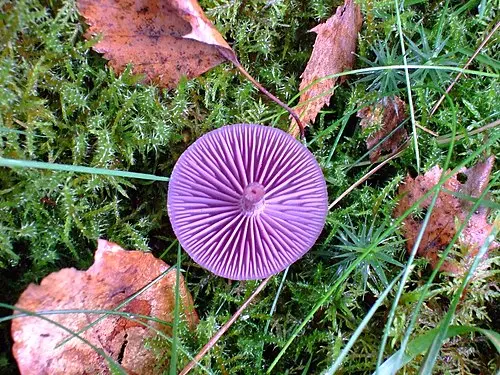 Andzandz / CC BY-SA 3.0
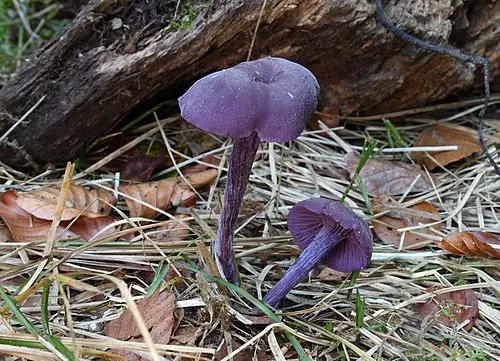 H. Krisp / CC BY 3.0