About this fungus
Angel's Wings is a fungus in the Marasmiaceae family. Its habitat and field characteristics are summarised below.
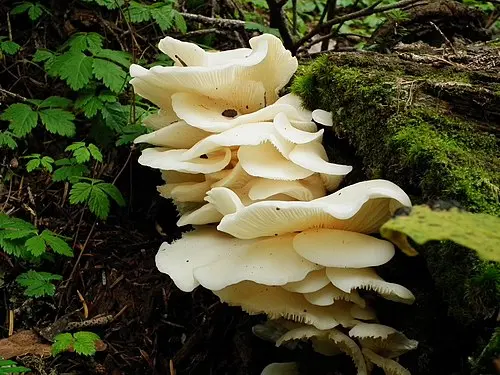
Thin white fans grow in overlapping tiers from a damp, decaying conifer log. Each cap is fan, tongue or petal shaped and attaches to the wood at a narrow point with little or no stem. The soft, pliant flesh and fine white gills give a more delicate impression than a typical Oyster Mushroom.
What to check
Confirm that the wood is from a conifer, since substrate is an important part of the identification. The underside has narrow, crowded gills radiating from the attachment point, and the spore print is white. The flesh is very thin and flexible, the surface is smooth, and no ring or veil is present. Microscopy shows nearly round spores.
Variation
Young caps are pure white with an inrolled edge. Older specimens can become cream or faintly yellow, with wavy, lobed or split margins. Crowded fruit bodies often press against one another and develop irregular outlines rather than a neat fan shape.
Lookalikes
True Oyster Mushrooms, Pleurotus species, are usually thicker and fleshier, often have a more noticeable lateral stem and are most often found on broadleaf wood. Their spores are longer and more cylindrical. Other small shelf fungi can overlap in shape, so white colour alone is not enough. Check flesh thickness, gills, substrate and spore print together.
Habitat and range
A saprotrophic fungus of well-rotted conifer logs, stumps and fallen branches, often where the wood is damp, soft and moss-covered. It fruits in troops or dense overlapping clusters in cool temperate and boreal forests across Europe, Asia and North America.
Food safety
Do not eat. Angel's Wings was once widely described as edible, but consumption was linked to a 2004 outbreak of acute encephalopathy in Japan involving 59 patients and 17 deaths. Most affected people were older and had kidney disease, although not every reported patient did. Symptoms could begin days or weeks later and included weakness, tremors, seizures and loss of consciousness. Research has proposed several interacting compounds, but the human mechanism is still not fully settled.
Photographs
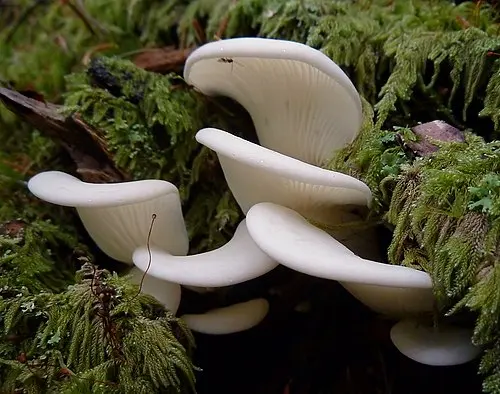 David Rust (incredulis) / CC BY-SA 3.0
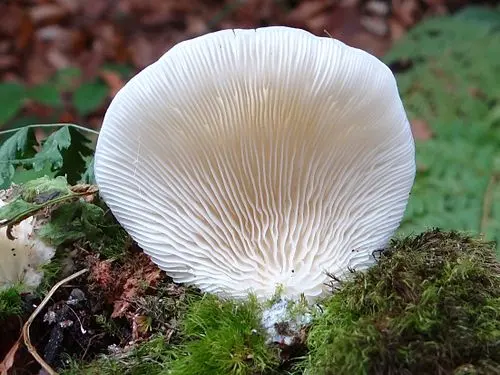 Jerzy Opioła / CC BY-SA 3.0