

About this fungus
Bark Bonnet is a fungus in the Porotheleaceae family. Its habitat and field characteristics are summarised below.
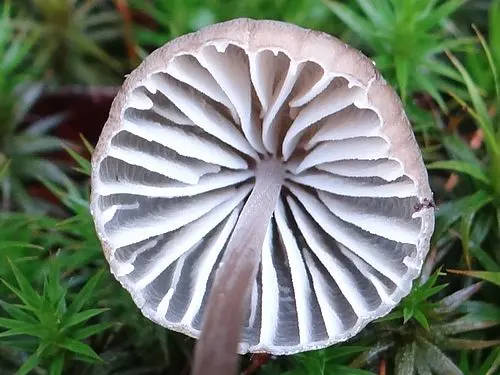
A very small, pale bonnet growing from bark, dead wood or moss over wood. Its thin cap is strongly lined at the margin, usually darker in the centre, and its widely spaced pale gills run down the slender stem.
What to check
Check the tiny size, translucent radial cap lines, pale widely spaced decurrent gills and growth directly from woody material. The cap centre may be shallowly depressed. There is no ring or volva. Exact separation from other small Phloeomana and Mycena-like fungi often needs microscopy.
Variation
Caps range from cream and beige to grey-brown, usually with a darker centre and paler margin. Shape changes from bell-like when young to convex or almost flat, sometimes with a central depression. Colour fades as the thin cap dries.
Lookalikes
Phloeomana hiemalis and several small Mycena-like fungi can share the pale striate cap and woody habitat. Gill attachment is useful but not always decisive. Mycena alcalina is a different fungus and should not be used as the reference page for this species.
Habitat and range
Saprotrophic on bark, fallen twigs, logs, cones and other dead wood from broadleaved or coniferous trees, often among moss. The habitat is broader than conifer wood alone and the species is recorded across Europe and other temperate regions.
Food safety
Inedible.
Photographs
 Jerzy Opioła / CC BY-SA 3.0