

About this fungus
Beechwood Sickener is a fungus in the Russulaceae family. Its habitat and field characteristics are summarised below.
A small to medium red brittlegill beneath beech, with white fragile gills and a white chalk-like stem. The cap may fade so strongly that colour alone is unreliable.
What to check
Confirm a brittle Russula structure: the gills chip rather than bend, the stem breaks with a chalk-like snap and no milk appears from damaged gills. Check that beech roots are present. Many red brittlegills under beech overlap in appearance, so macroscopic features may not provide a certain species identification.
Variation
The cap can be crimson, scarlet, pink, patchily faded or almost white, sometimes with a darker centre. It begins rounded or convex and usually becomes flatter, occasionally shallowly depressed, with age.
Lookalikes
The Sickener is very similar but is associated mainly with conifers and wet acidic ground. Other red Russula species can also grow with beech, including species that cannot be separated reliably without microscopy, chemical reactions or DNA. The tree association narrows the possibilities but does not prove the name.
Habitat and range
Ectomycorrhizal with beech in woodland, parkland and other places where beech roots extend. It is principally a European species. Similar red brittlegills elsewhere should not automatically be given this name.
Food safety
Poisonous.
Photographs
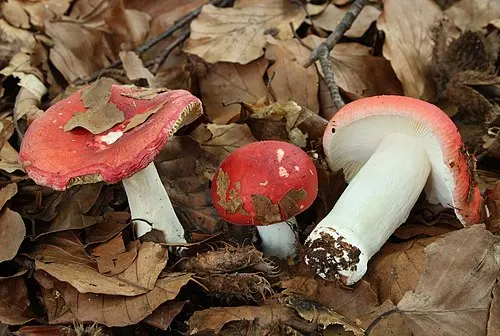 H. Krisp / CC BY 3.0