

About this fungus
Beefsteak Polypore is a fungus in the Fistulinaceae family. Its habitat and field characteristics are summarised below.
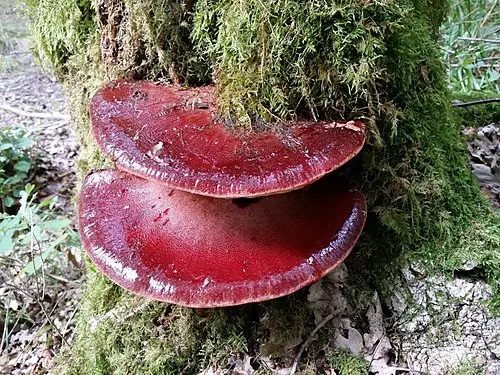
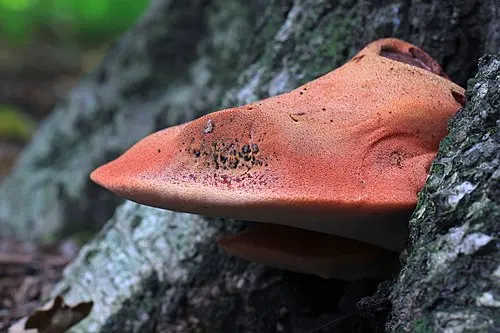
A thick, moist bracket shaped like a tongue or liver, usually growing low on an old oak or sweet chestnut. The upper surface is pink-red to liver-red, and a section shows marbled red flesh with pale veins and reddish sap.
What to check
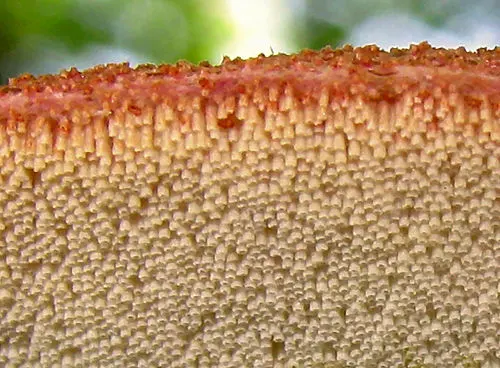
Look beneath for tightly packed cream to yellowish tubes that remain physically separate, like tiny drinking straws, rather than sharing walls as ordinary polypore pores do. They bruise reddish-brown. The pinkish spore print, fleshy texture and marbled interior support the identification.
Variation
Young fruit bodies may be pink or orange-red with a smooth moist skin. Older brackets deepen to wine-red or purple-brown, become rougher and tougher, and their pore surface darkens after bruising or drying.
Lookalikes
Cinnamon Bracket, Hapalopilus rutilans, is smaller, thinner and cinnamon-brown rather than marbled and meat-like, but it has caused severe poisoning after being mistaken for Beefsteak Polypore. Shaggy Bracket, Inonotus hispidus, has a hairy upper surface and conventional fused pores. A red upper surface alone is not enough: check the separate tubes and interior.
Habitat and range
Parasitic and later saprotrophic on broad-leaved wood, especially old oak and sweet chestnut, and occasionally other hardwoods in different regions. It causes brown rot and may fruit from living trunks, wounds, stumps or exposed roots.
Food safety
Edible.
Use this profile to learn what to examine and compare, not as proof that a mushroom is safe to eat. Check the whole specimen and every important lookalike before reaching an identification.
Photographs
 Kean10 / CC BY-SA 4.0
 Stu's Images / CC BY-SA 3.0
 Dan Molter (shroomydan) / CC BY-SA 3.0