
About this fungus
Birch Polypore is a fungus in the Fomitopsidaceae family. Its habitat and field characteristics are summarised below.
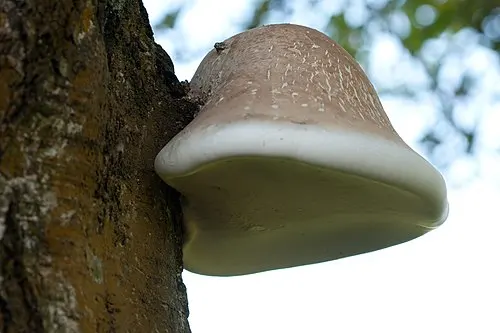
A smooth, pale annual bracket growing directly from birch bark, often rounded, kidney-shaped or hoof-like. A thick white margin curves around the cap above a white to cream surface packed with minute pores.
What to check
Confirm the host is birch and inspect both surfaces. Young brackets have a pale buff to grey-brown papery skin, firm white flesh and a white or cream underside with roughly three to five tiny pores per millimetre. They are rubbery when fresh and become corky, brittle and darker with age. The fruit body has a short thick lateral attachment rather than a central stem, and no gills.
Variation
New brackets can be almost spherical before expanding into a shelf. Caps darken from whitish or pale buff to grey-brown, and the skin may crack with age. Each bracket grows for one season, although dry old fruit bodies often persist beside fresher growth.
Lookalikes
Fomes fomentarius also occurs on birch but is harder, greyer, more sharply hoof-shaped and perennial, with layered growth. Cerioporus squamosus has conspicuous dark scales and occurs on many broadleaved hosts. Host, pore surface, texture and annual structure should be considered together.
Habitat and range
A specialist brown-rot fungus of birch. It can act as a weak parasite on stressed living trees and continues as a saprobe after the wood dies. Fruiting bodies occur on standing dead, dying and fallen trunks across the birch range of the Northern Hemisphere.
Food safety
Edibility is uncertain or disputed.
Photographs
 Slick / CC0
 Slick / CC0