
About this fungus
Bitter Oysterling is a fungus in the Mycenaceae family. Its habitat and field characteristics are summarised below.
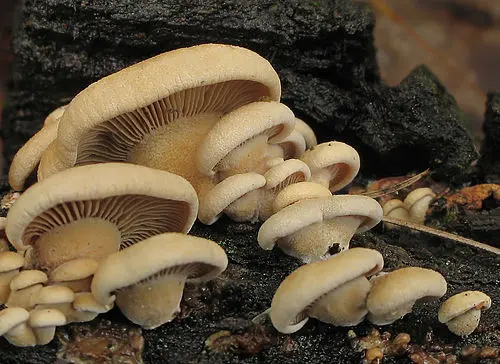
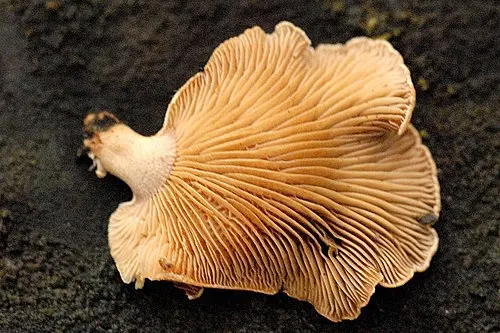
A small, tough oyster-shaped fungus forming crowded shelves on dead broadleaved wood. The tan to cinnamon cap has a short lateral stem, and the underside carries crowded gills with conspicuous cross-connections.
What to check
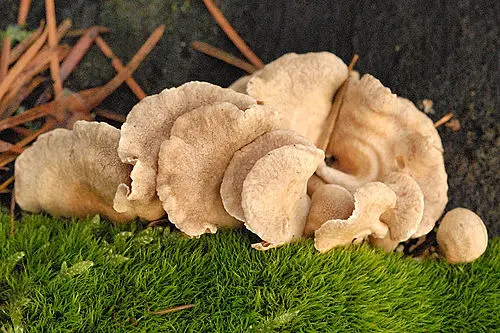
Check the dry, finely hairy or scurfy fan-shaped cap, the lateral or off-centre short stem and gills that are attached to slightly decurrent rather than free. Cross-veins between the gills can form a mesh. There is no ring or volva, and the spore print is white.
Variation
Fresh caps may be pale cream or buff and become tan, cinnamon or brown with age. The margin begins inrolled and later becomes wavy or wrinkled. Bioluminescence varies geographically and between strains, so failure to glow has no value for excluding the species.
Lookalikes
Crepidotus species share the fan-shaped growth but have a brown spore print. Sarcomyxa serotina is larger, fleshier and usually olive-toned with yellowish gills. Other small Panellus and Resupinatus species can require microscopy.
Habitat and range
Saprotrophic in overlapping groups on logs, branches, stumps and wounds of broadleaved trees, especially oak. It occurs across temperate regions. Bioluminescent strains are known mainly from eastern North America, while European, Asian, New Zealand and many western North American collections do not glow.
Food safety
Inedible.
Photographs
 James Lindsey / CC BY-SA 3.0
 James Lindsey / CC BY-SA 3.0