

About this fungus
Black Morel is a fungus in the Morchellaceae family. Its habitat and field characteristics are summarised below.
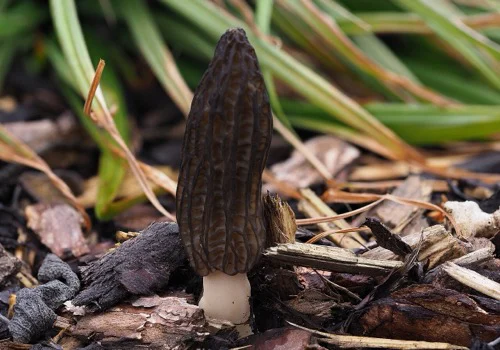
A conical black morel with deep honeycomb pits, mainly vertical ridges that darken with age, and a pale hollow stem.
What to check
A complete lengthwise section should be hollow through cap and stem, with the cap joined along its lower edge. Confirm true pits and ridges rather than broad convoluted folds. These checks establish a true morel, but the name M. elata cannot be assigned to every black morel worldwide from appearance alone.
Variation
Young ridges are grey-brown and become dark brown or black as the cap matures. Black morel form overlaps across multiple DNA-defined species, so cap colour and ridge direction are not sufficient for exact naming.
Lookalikes
Gyromitra species have more irregular brain-like or lobed caps and may contain gyromitrin. Verpa species differ in cap attachment and can cause illness. North American black morels formerly called M. elata include Morchella angusticeps, M. importuna and other regional species.
Habitat and range
The European M. elata name has a narrower modern meaning than older field guides suggest. Black morels occur in spring on woodland and disturbed soil, including woodchip, but habitat and continent must be considered before choosing an exact species name.
Food safety
Edible, with caution.
Use this profile to learn what to examine and compare, not as proof that a mushroom is safe to eat. Check the whole specimen and every important lookalike before reaching an identification.
Photographs
 Lukas Large / CC BY-SA 2.0