

About this fungus
Black Witches' Butter is a fungus in the Auriculariaceae family. Its habitat and field characteristics are summarised below.
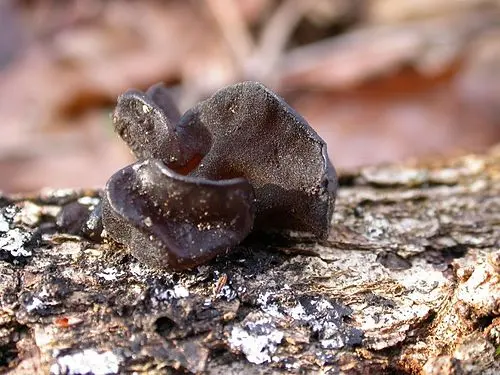
Small black to very dark brown jelly bodies attached to dead broadleaf wood. They are usually distinct, button-like, cup-like or top-shaped rather than forming one broad brain-like sheet.
What to check
When wet, each body is rubbery and gelatinous, with a shiny upper surface dotted by tiny pimples. The underside is duller and can develop minute gelatinous spines. In dry weather it shrivels to a flattened black crust and expands again after rain.
Variation
Fresh bodies may be black, sepia or dark brown and can grow singly or in small crowded groups. Age, frost and drying greatly alter their outline, so the tendency to remain individually defined matters more than one precise shape.
Lookalikes
Exidia nigricans begins as buttons but quickly coalesces into larger irregular lobed or brain-like masses. The two were historically confused and older photographs and North American records may use the names inconsistently. Phaeotremella foliacea forms broader leafy brown lobes, while Yellow Brain is bright yellow.
Habitat and range
Saprotrophic on attached or fallen dead branches and logs of broadleaved trees, including oak, hazel and beech. Host species alone does not reliably separate it from Exidia nigricans. The exact North American distribution remains affected by older name confusion.
Food safety
Inedible.
Photographs
 Jean-Jacques MILAN / CC BY-SA 3.0