
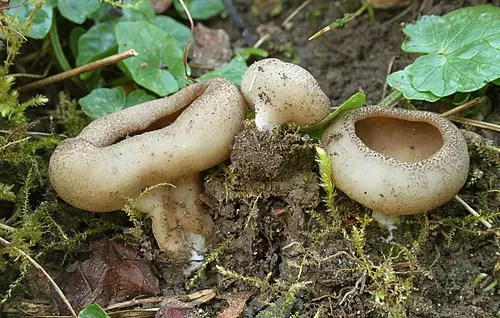
About this fungus
Bleach Cup is a fungus in the Morchellaceae family. Its habitat and field characteristics are summarised below.
A substantial spring cup fungus that can spread into an irregular saucer lying close to the ground. The fertile inner surface is yellow-brown, grey-brown or deeper brown and often develops a network of broad wrinkles towards the centre. Its outer surface and curled edge are much paler, from cream to almost white, and any stem is reduced to a short, buried pinch at the base.
What to check
Check the contrast between the brown inner surface and the whitish to pale tan outer surface. Young fruit bodies are deep cups with thick inrolled rims; older ones flatten, split and become irregular, and the central wrinkles may become prominent. The flesh is pale and brittle. European collections often release a bleach-like or chlorine-like smell when broken, but North American collections may have little or no distinctive smell, so its absence does not rule the species out. There are no gills, ring or volva. Smooth, large spores without oil droplets provide useful microscopic confirmation.
Variation
Young cups can be surprisingly pale and smooth, while mature fruit bodies become broad, brown and strongly folded. The central veining is often the most memorable feature, but it is weak or absent in some specimens. Size descriptions range from a few centimetres to about 20 cm across. The bleach-like smell appears to vary geographically, which may reflect either population differences or more than one species being included under the name.
Lookalikes
Other brown spring cup fungi can be almost identical in the field. Peziza, Discina, Gyromitra and related cups overlap in colour, shape and season, and some require spore and tissue characters for separation. Morels fruit at the same time but have a raised honeycomb of pits and ridges on a distinct cap rather than a smooth cup with low central veins. The brown folded surface alone is not enough to separate this species, and a missing bleach smell is especially unhelpful in North America.
Habitat and range
Fruits on soil in spring, singly, scattered or in small groups. European accounts often place it beneath beech and in lightly wooded or grassy places, while North American accounts emphasise hardwood forests; other records occur among moss and conifer litter, sometimes on banks and slopes. Its ecology remains unsettled and may combine saprotrophic growth with a facultative relationship to roots. European and North American populations have not yet been shown conclusively to be one phylogenetic species.
Food safety
Edibility is uncertain or disputed.
Photographs
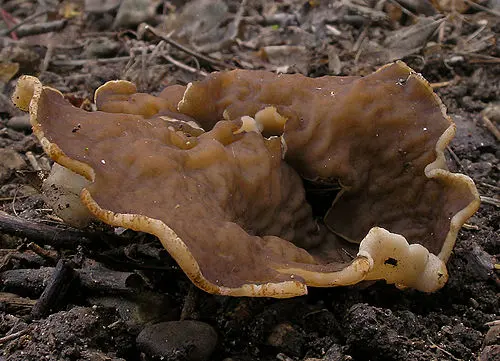 Andreas Kunze / CC BY-SA 3.0