

About this fungus
Bleeding Fairy Helmet is a fungus in the Mycenaceae family. Its habitat and field characteristics are summarised below.
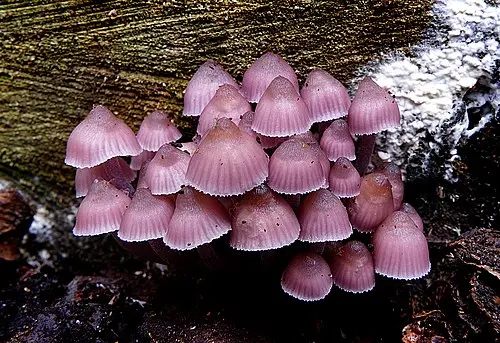
A delicate wine-brown bonnet growing in tight tufts on decaying wood. Fresh fruit bodies release dark red-brown latex when the fragile stem or flesh is damaged.
What to check
Look for clustered growth from wood, conical to bell-shaped caps with lined margins, pale gills and reddish stems. Fresh damaged tissue releases dark wine-red latex. There is no ring or volva, but the bleeding reaction is shared with a few related Mycena and must be combined with habitat and form.
Variation
Moist caps are dark reddish-brown and visibly lined near the margin. As they dry they fade through pinkish brown to pale grey-pink. Older or dry mushrooms may release little latex, so a missing droplet does not exclude the species.
Lookalikes
Mycena sanguinolenta also releases reddish latex but is smaller and usually grows among litter, moss or grass rather than in fused clusters on substantial wood. Other regional latex-bearing Mycena may need microscopic study. Substrate and clustered growth are important alongside the latex colour.
Habitat and range
Saprotrophic in clusters on decaying logs, trunks, stumps and larger fallen branches, most often broadleaved wood. It is widespread in northern temperate regions, and occasional conifer records mean oak or another single host should not be treated as essential.
Food safety
Inedible.
Photographs
 Ron Pastorino / CC BY-SA 3.0
 Bernard Spragg / Public Domain Mark