
About this fungus
Blushing Wood Mushroom is a fungus in the Agaricaceae family. Its habitat and field characteristics are summarised below.
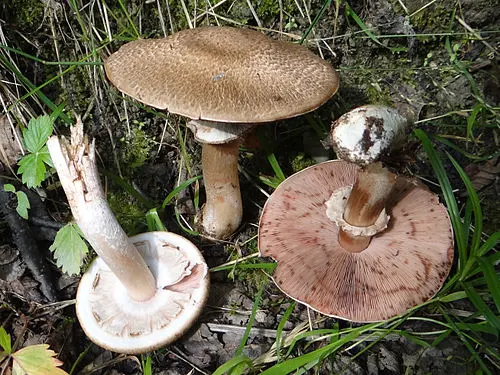
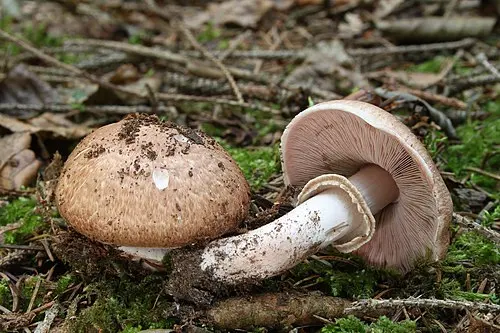
A brown, scaly woodland mushroom whose white flesh turns red when cut. Young specimens have pink gills, while mature ones develop the dark brown gills and spores typical of Agaricus.
What to check
Check for a brown cap covered in pressed fibres or scales, free crowded gills that change from pink to dark brown, a stem ring, no volva at the base, and white flesh that reddens before becoming brownish. Use the full combination because several woodland Agaricus species also redden.
Variation
The cap can be lightly fibrous or strongly scaly, and its ground colour ranges from pale ochre-brown to dark brown. Reddening is usually clearest in freshly cut flesh and may become duller on older or weathered mushrooms.
Lookalikes
Agaricus langei is an especially close red-staining woodland relative and may need microscopic or DNA evidence for a confident separation. Yellow-staining Agaricus species usually show chrome-yellow flesh, often strongest at the stem base, and some have a phenolic or inky odour. Young Agaricus should be checked from the side and underneath so that free pink-to-brown gills and the complete stem base are visible; a volva or persistently white gills indicate a different genus.
Habitat and range
A saprotroph on soil rich in leaf litter, humus or needles in coniferous, broadleaved and mixed woodland. It may also appear near trees in parks, verges and other wooded ground.
Food safety
Edible.
Use this profile to learn what to examine and compare, not as proof that a mushroom is safe to eat. Check the whole specimen and every important lookalike before reaching an identification.
Photographs
 Holger Krisp / CC BY 3.0