

About this fungus
Bonfire Scalycap is a fungus in the Strophariaceae family. Its habitat and field characteristics are summarised below.
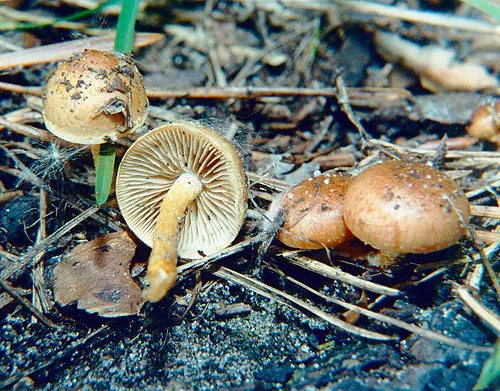
A small sticky orange-brown to reddish-brown mushroom that appears on burnt soil, charcoal and fire-damaged woody debris. Gills begin pale and become cinnamon-brown as the spores mature.
What to check
Confirm genuinely burnt substrate, a viscid cap, cinnamon-brown mature gills and spores, and a faint fibrillose ring zone rather than a durable ring. There is no volva. Several pyrophilous Pholiota look alike, so microscopy or DNA is needed for exact species identification.
Variation
Wet caps are darker and more orange or red-brown; dry caps fade to buff or pink-brown. Veil traces can disappear, and ash can obscure stem and cap colours. Fruiting may be abundant at some sites and absent as the habitat recovers.
Lookalikes
Pholiota brunnescens, Pholiota castanea and Pholiota molesta share burnt-ground ecology and overlapping colours. Modern type studies separate them using spores, cystidia and DNA. Other brown mushrooms may colonise fire sites, so charcoal alone is not conclusive.
Habitat and range
A fire-associated saprotroph on burnt forest soil, charcoal, charred wood and old bonfire sites. It may appear from the first season to several years after fire and is widespread in North America, with related or historically confused taxa elsewhere.
Food safety
Inedible.
Photographs
 Аимаина хикари / Public Domain