
About this fungus
Brown Birch Bolete is a fungus in the Boletaceae family. Its habitat and field characteristics are summarised below.
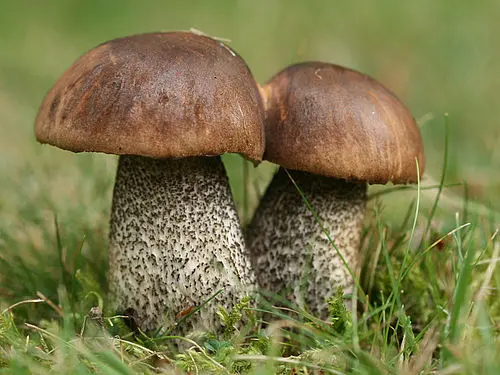
A brown-capped bolete found with birch. Its underside has pores, not gills, and its pale stem is densely covered with dark brown to blackish rough scales called scabers.
What to check
Confirm that birch roots are nearby, inspect the pale pores and follow the stem to its complete base. The flesh is usually white and changes little, although a faint pinkish flush may occur. It should not show the strong blue-green reactions seen in some close birch Leccinum species.
Variation
Caps range from pale hazel to dark brown and become smoother or sticky in wet weather. Pores start whitish and become grey-buff or brownish with age. The density and colour of stem scabers also change as the mushroom matures.
Lookalikes
Several birch-associated Leccinum species are extremely similar. Leccinum cyaneobasileucum develops blue-green colour at the stem base, while orange-capped members of the Leccinum versipelle group usually show stronger colour changes. Old or incomplete specimens may not be separable confidently without microscopy or regional expertise.
Habitat and range
Ectomycorrhizal with birch, fruiting on soil in birch woodland, scrub, parks and mixed woodland where birch roots are present. The European concept is well established, but the name has also been used broadly for similar North American scaber-stalks, so users outside Europe should consult regional treatments.
Food safety
Edible.
Use this profile to learn what to examine and compare, not as proof that a mushroom is safe to eat. Check the whole specimen and every important lookalike before reaching an identification.
Photographs
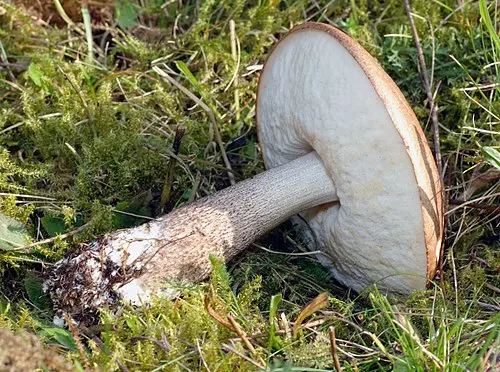 André Karwath (Aka) / CC BY-SA 2.5
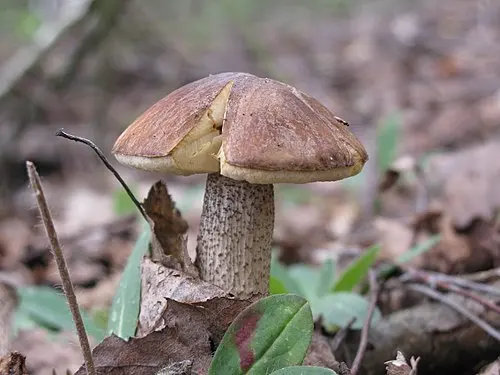 jdx / CC BY-SA 3.0
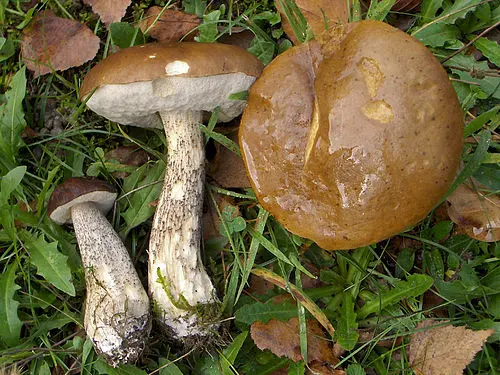 vesna maric (kalipso) / CC BY-SA 3.0