

About this fungus
Brown Roll-Rim is a fungus in the Paxillaceae family. Its habitat and field characteristics are summarised below.
A sturdy ochre, olive-brown or rusty-brown woodland mushroom with a thick cap edge that remains rolled underneath. The cap starts convex, then flattens and becomes funnel-shaped. Its crowded gills run down the stem and darken quickly when handled.
What to check
Press or lightly scrape a gill and watch for rapid reddish-brown to dark brown staining. The pale yellow to ochre gills are soft, often fork and join near the stem, and can be peeled from the cap flesh as a layer. Check for a persistently inrolled, felted margin, a brown spore print and the absence of both ring and volva.
Variation
Young caps can be pale ochre or olive-brown with a downy surface. Older fruit bodies become smoother, darker and more deeply depressed, and wet caps feel sticky. Bruised areas can turn rusty, wine-red or very dark brown within minutes. The rolled margin becomes less pronounced late in development but is usually still visible.
Lookalikes
The name Paxillus involutus has historically covered a complex of similar species. Coppery Roll-Rim, Paxillus cuprinus, is especially associated with planted birch in brighter parks and lawns, while other members differ in subtle colour, habitat and microscopic features. Velvet Roll-Rim has a velvety cap, a dark velvety stem and grows from conifer wood. Treat all Paxillus species as unsafe.
Habitat and range
An ectomycorrhizal fungus found on soil with a wide range of broadleaf and conifer hosts. Birch is a frequent partner, but records also involve willow, poplar, oak, beech, pine and spruce. It occurs in forests, heaths, parks, gardens and grassland across temperate and boreal parts of the Northern Hemisphere, with introduced populations elsewhere.
Food safety
Deadly poisonous. Brown Roll-Rim was eaten widely in the past, and several fatal patients had previously eaten it without becoming ill. A rare reaction known as Paxillus syndrome can cause the rapid destruction of red blood cells, shock, clotting failure and kidney or other organ failure. Prior immune sensitisation is the leading explanation, although the exact mechanism is not fully resolved. Past uneventful meals do not show that a future meal will be safe.
Photographs
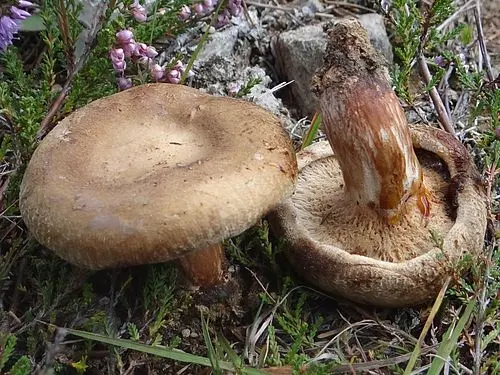 Selso / CC BY-SA 3.0
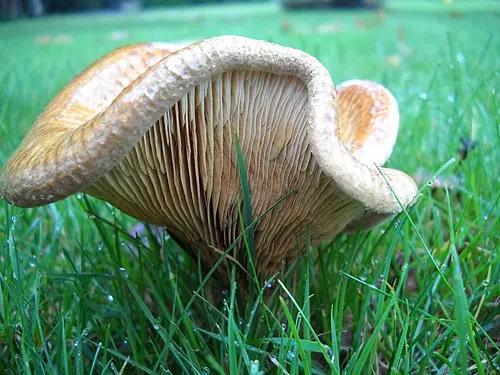 Tim Sage / CC BY-SA 3.0
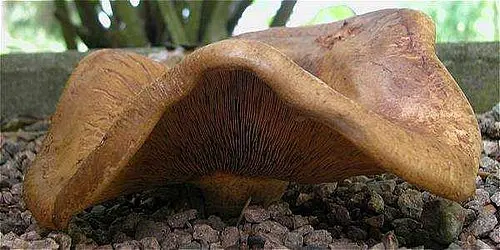 Jost Jahn