
About this fungus
Burnt Knight is a fungus in the Tricholomataceae family. Its habitat and field characteristics are summarised below.
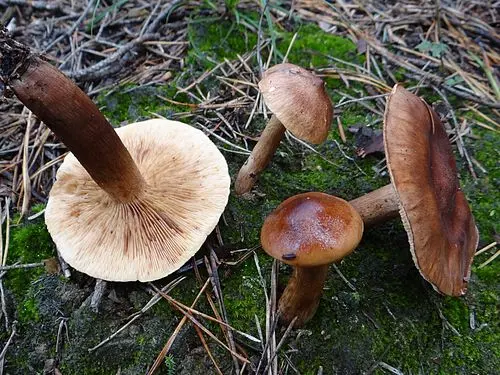
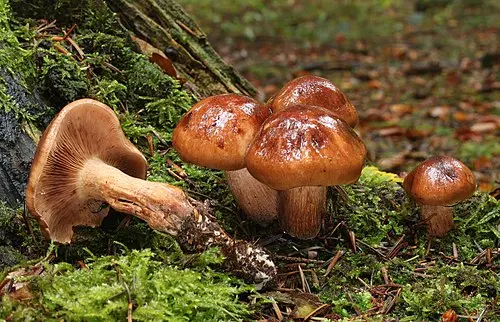
A brown woodland mushroom with a smooth cap that becomes distinctly sticky in wet weather. The cap is usually chestnut-brown, paler at the edge and darker at the centre, and may look blackened as it ages. The pale gills develop rusty-brown spots, while the ringless stem is white above and increasingly brown-fibred below.
What to check
Look for a wet, glossy cap, crowded pale gills with a clear notch near the stem, and rusty spotting that develops with age. The fibrous stem has no ring and its white flesh may turn reddish-brown when cut or bruised. Association with beech is useful supporting context, but nearby trees and cap colour are not enough to confirm the species.
Variation
Young caps can be a lighter yellow-brown, while older caps become deeper chestnut or nearly black in places. The sticky surface is most obvious after rain and may hold fragments of leaf litter. Rusty marks on the gills are age-related, so they can be absent from fresh specimens.
Lookalikes
Several brown-capped Tricholoma species overlap closely. Tricholoma ustaloides often has a sharply defined white area at the top of the stem, while Tricholoma fulvum is more closely associated with birch and wetter ground. These are supporting comparisons rather than simple field tests, and difficult collections may need specialist examination.
Habitat and range
A mycorrhizal species of broadleaf woodland, especially with beech and hornbeam, and also recorded with oak, birch, lime and hawthorn. It fruits on the ground, usually in small groups. Its frequent association with beech means it is often found on neutral or alkaline soil, but host and soil patterns vary across its range.
Food safety
Poisonous.
Photographs
 H. Krisp / CC BY 3.0