
About this fungus
Buttery Collybia is a fungus in the Omphalotaceae family. Its habitat and field characteristics are summarised below.
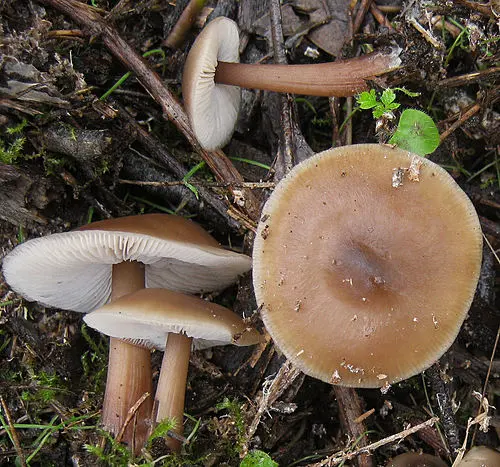
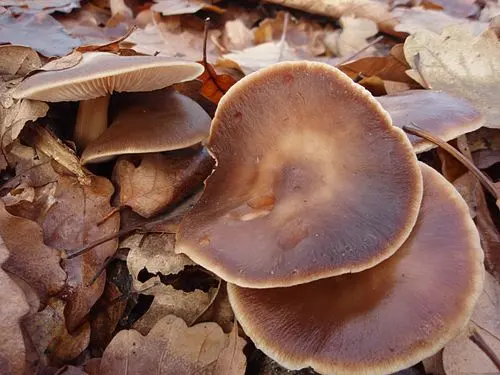
A variable woodland-litter mushroom with a smooth moist cap that feels slightly greasy or buttery when fresh. The cap is usually reddish or chestnut brown but can fade strongly as it dries.
What to check
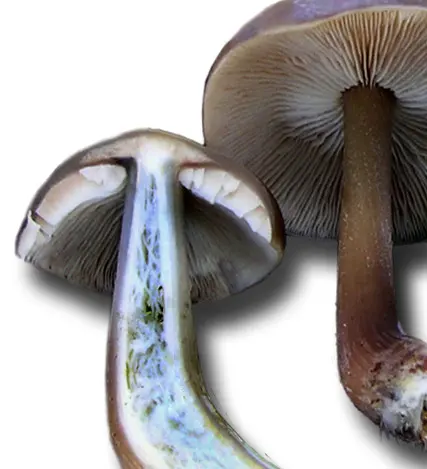
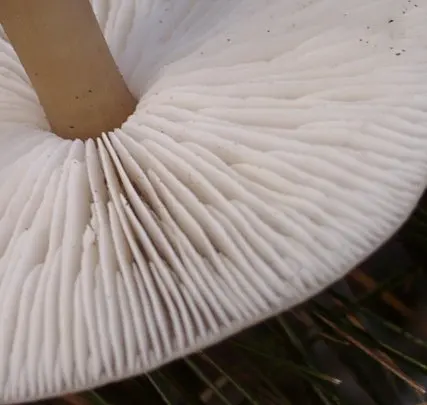
Look for a greasy, hygrophanous cap, crowded whitish to cream gills that are narrowly attached or notched, and a tough ringless stem that usually broadens into a club-shaped base with pale woolly growth. A cream, buff or pinkish-buff spore print is more useful than cap colour alone.
Variation
Moist caps can be dark red-brown or chestnut and become pale ochre-brown as they dry. Grey-brown, horn-grey or nearly cream specimens have often been called form asema; some current treatments recognise Rhodocollybia asema separately, so pale collections deserve caution.
Lookalikes
Gymnopus dryophilus can grow in similar litter but usually has a drier cap, a less swollen stem base and a white rather than buff or pinkish-buff spore print. Rhodocollybia maculata is paler and develops rusty spots, while R. prolixa is more reddish and often has a twisted stem.
Habitat and range
A litter-decaying fungus in coniferous and broadleaf woodland, often among pine or spruce needles but also in deciduous leaf litter. It grows singly, scattered or in loose troops across temperate regions.
Food safety
Edible.
Use this profile to learn what to examine and compare, not as proof that a mushroom is safe to eat. Check the whole specimen and every important lookalike before reaching an identification.
Photographs
 Lamiot / CC BY-SA 3.0
 Christian Schulte / CC BY-SA 3.0
 Horst / CC BY 3.0
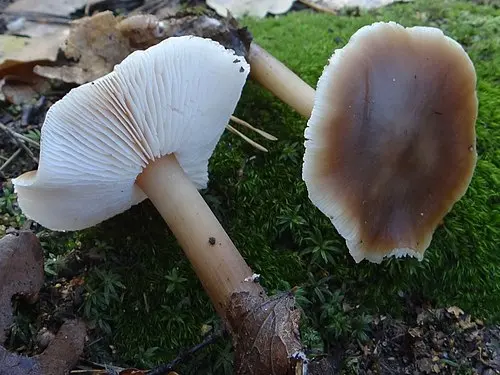 Jerzy Opioła / CC BY-SA 3.0
Species to compare
Similar mushrooms to compare against: