
About this fungus
Candlesnuff Fungus is a fungus in the Xylariaceae family. Its habitat and field characteristics are summarised below.
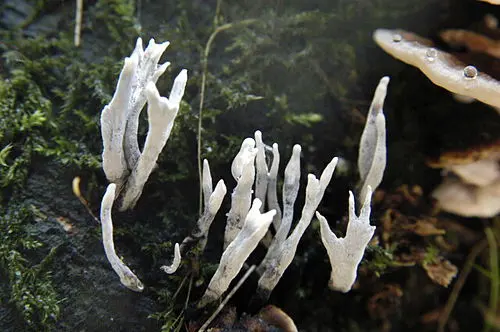
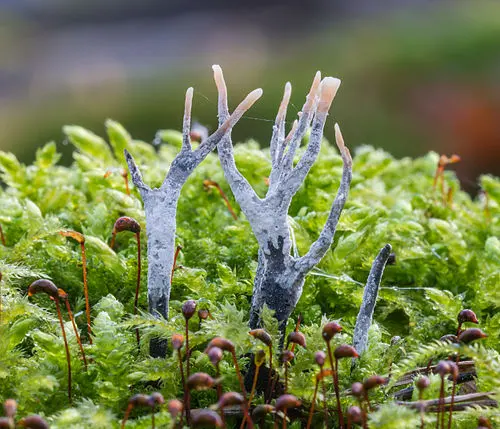
Small, tough, upright fingers with black bases and pale powdery, often branched tips, usually clustered on dead wood. Their forked outline gives rise to the alternative name carbon antlers.
What to check
Look for narrow stromata about 2 to 8 cm tall, tough rather than fleshy, arising directly from decaying wood. Actively growing branches are coated in white or grey powder made of asexual spores. Later they become charcoal-black and develop tiny raised dots, the openings of embedded flask-shaped structures that release black sexual spores. The transition between these stages is more useful than colour alone.
Variation
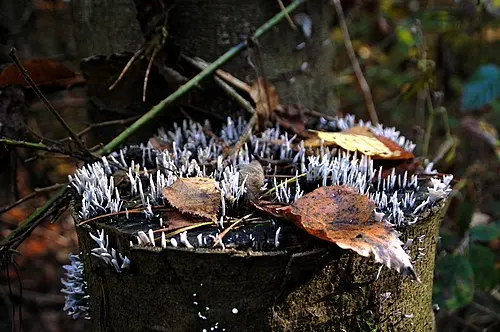
Some fruit bodies are simple pointed clubs and others branch repeatedly. White conidial coating can cover much of a young stroma or remain only at the tips, while older colonies may be almost entirely black. Several stages often occur together on one stump.
Lookalikes
Xylaria polymorpha is normally thicker, blunt and less branched. Xylaria carpophila is more slender and characteristically grows from buried beech mast. Other small Xylaria can overlap in shape, and old black specimens may need microscopy or sequence evidence for a secure species name.
Habitat and range
Saprobic on decaying wood, especially fallen branches and stumps of broadleaved trees, with occasional records from conifer wood. It can fruit for much of the year in damp temperate woodland.
Food safety
Inedible.
Photographs
 Norbert Nagel / CC BY-SA 3.0
 Achim Raschka / CC BY-SA 3.0
Species to compare
Similar mushrooms to compare against: