
About this fungus
Candy Cap is a fungus in the Russulaceae family. Its habitat and field characteristics are summarised below.
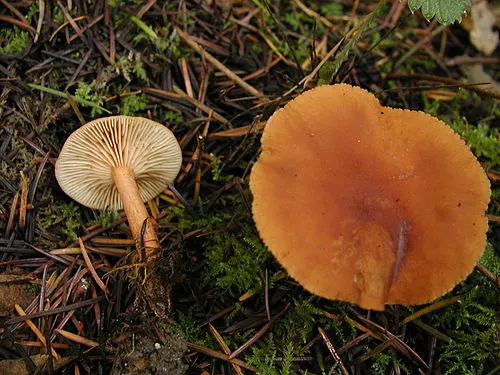
A small rusty brown to orange-brown milkcap from the Pacific coast of North America. Fresh mushrooms may have only a faint sweet scent, but dried material develops the strong maple syrup, burnt sugar or fenugreek aroma behind the common name.
What to check
Confirm a brittle milkcap with watery, scant latex that does not stain the flesh, together with pale pinkish buff to very pale orange gills that attach broadly or run slightly down the stem. The cap is dry or slightly sticky, usually smooth apart from minor wrinkles, and the stem is smooth and coloured much like the cap. Aroma is supportive but cannot establish the species by itself.
Variation
Young caps are convex and may have a slightly inrolled margin. They become flat or shallowly depressed and sometimes develop a small central bump or a wavy upturned edge. Colour ranges through rusty, reddish and orange-brown. The sweet aroma is often much less obvious when fresh than after drying.
Lookalikes
Several reddish western milkcaps are similar. Lactarius rufulus is usually larger and has a weaker dried aroma. Lactarius rufus, L. xanthogalactus, L. luculentus and L. Lactarius camphoratus is a smaller Eurasian and eastern North American relative whose name was formerly misapplied to western Candy Caps. Smell alone is not enough for a food identification.
Habitat and range
Mycorrhizal with western North American oaks, tanoak and Douglas fir. It grows on soil and litter in mixed broadleaf and conifer woodland, singly, scattered, in groups or in loose clusters, mainly during the autumn and winter rainy season. The strict species is associated with the Pacific coast rather than being a general worldwide woodland mushroom.
Food safety
Choice edible.
Use this profile to learn what to examine and compare, not as proof that a mushroom is safe to eat. Check the whole specimen and every important lookalike before reaching an identification.
Species to compare
Similar mushrooms to compare against: