

About this fungus
Cauliflower Fungus is a fungus in the Sparassidaceae family. Its habitat and field characteristics are summarised below.
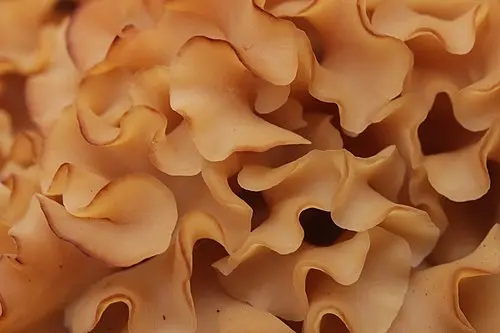
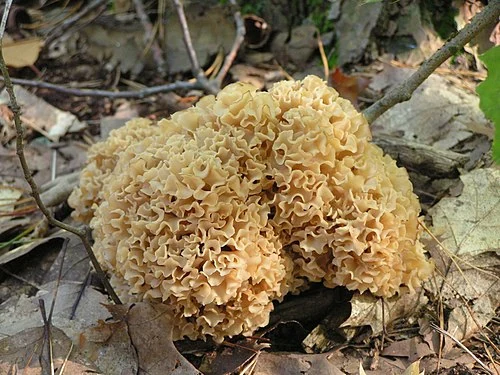
A large cream cauliflower-like mass of tightly curled, flattened lobes at the base of a conifer, with no conventional cap, gills or pores.
What to check
Follow the repeatedly folded ribbon-like lobes to a single thick rooting base. There is no ring or volva. In Europe, association with pine is an important clue; host and region must be checked because other Sparassis look similar.
Variation
Young fruit bodies are white to cream or pale ochre and darken to tan or brown with age. Lobe width and curliness vary and can overlap with related species.
Lookalikes
Sparassis species in North America and Asia can look very similar but differ in host range and microscopic or genetic characters. Hen of the Woods has distinct grey-brown fan-shaped caps with pores and is usually associated with broadleaved trees.
Habitat and range
The strict European S. crispa is a root and butt-rot fungus primarily of pine. Records beneath spruce, fir, cedar or hardwoods, especially outside Europe, may represent S. brevipes, S. americana, S. radicata or other regional species.
Food safety
Choice edible.
Use this profile to learn what to examine and compare, not as proof that a mushroom is safe to eat. Check the whole specimen and every important lookalike before reaching an identification.
Photographs
 Björn S. / CC BY-SA 2.0
 Attribution pending