

About this fungus
Charcoal Burner is a fungus in the Russulaceae family. Its habitat and field characteristics are summarised below.
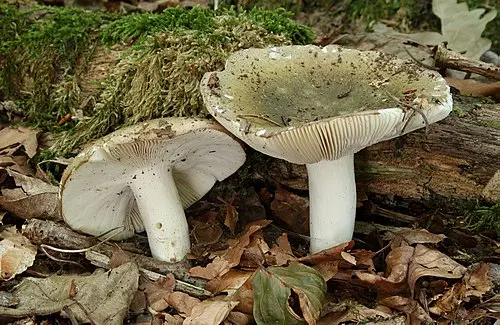
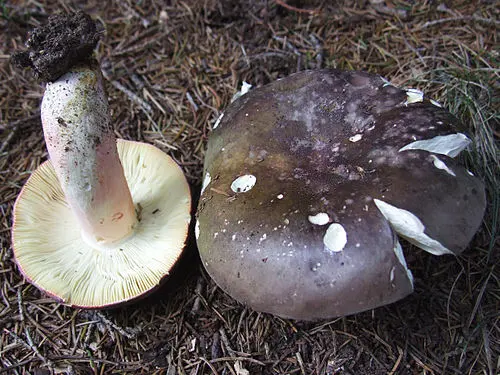
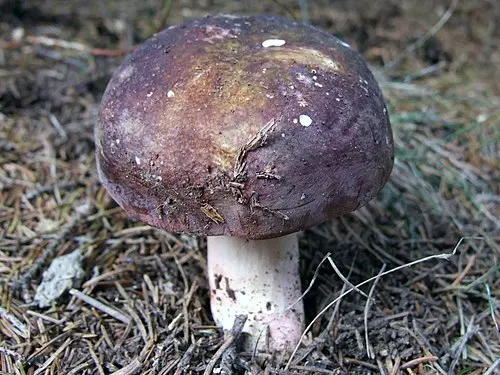
A sturdy woodland brittlegill with an exceptionally variable cap, often mixing purple, slate-grey, green, olive and brown. Cap colour is much less useful than its unusual gills, which are flexible rather than readily shattering.
What to check
Look for white to cream gills that feel soft, slightly greasy and flexible when young, bending under gentle pressure instead of breaking like most Russula gills. The cap is 4 to 15 cm across and often mottled or finely radially veined. The white stem and flesh remain brittle, the spore print is white, and there is no ring or volva. Mature or dry gills can lose some flexibility, so use the whole combination.
Variation
The cap may be violet, purple-brown, slate-grey, blue-green, olive or a patchwork of several colours. Some fruit bodies are almost uniformly green. North American collections historically called R. cyanoxantha may include species distinct from the European taxon.
Lookalikes
Russula grisea and other blue-green brittlegills normally have more brittle gills. Russula olivacea has a cream to yellow spore print rather than white, and Russula xerampelina develops a fishy smell and brown staining. Flexible gills are a strong clue, not a food-safety guarantee or a substitute for regional identification.
Habitat and range
Ectomycorrhizal on woodland soil. European accounts emphasise beech and oak, with other broadleaved trees and occasional conifers. North American accounts include both hardwoods and conifers but also warn that the name may cover several taxa.
Food safety
Choice edible.
Use this profile to learn what to examine and compare, not as proof that a mushroom is safe to eat. Check the whole specimen and every important lookalike before reaching an identification.
Photographs
 H. Krisp / CC BY 3.0
 Jerzy Opioła / CC BY-SA 4.0
 Jerzy Opioła / CC BY-SA 4.0