
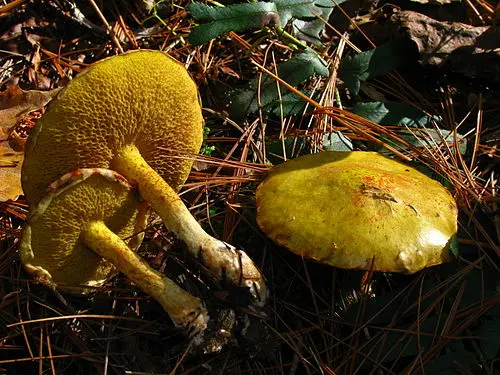
About this fungus
Chicken Fat Mushroom is a fungus in the Suillaceae family. Its habitat and field characteristics are summarised below.
A sticky bright yellow eastern North American bolete, often streaked with reddish fibrils and clustered under eastern white pine.
What to check
Confirm large angular yellow pores that run slightly down the stem and may mark reddish-brown, a yellow stem with reddish glandular dots, and ragged veil remnants on the young cap margin. A persistent ring and volva are absent. Host identity is essential.
Variation
Caps range from mustard-yellow to yellow-brown and become strongly slimy when wet. Reddish streaks may be sparse or cover much of the cap, while veil remnants disappear with age.
Lookalikes
Suillus sibiricus and related five-needle-pine Suillus are very similar but differ in regional range and host. Suillus subaureus associates mainly with broad-leaved trees. Microscopy may be needed when host and geography do not fit clearly.
Habitat and range
Ectomycorrhizal primarily with eastern white pine in eastern North America, often fruiting in clusters from summer into autumn. Reports from other continents or different pines need regional verification.
Food safety
Edible.
Use this profile to learn what to examine and compare, not as proof that a mushroom is safe to eat. Check the whole specimen and every important lookalike before reaching an identification.
Photographs
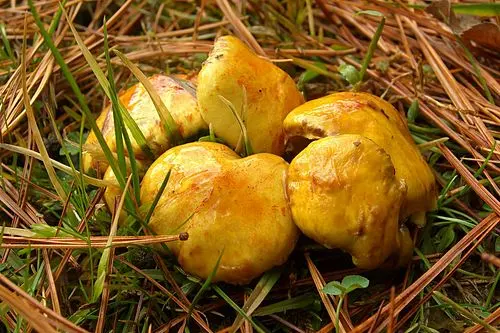 Jason Hollinger / CC BY-SA 3.0