

About this fungus
Chicken Of The Woods is a fungus in the Fomitopsidaceae family. Its habitat and field characteristics are summarised below.
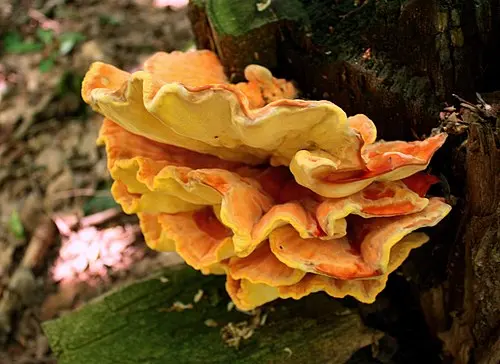
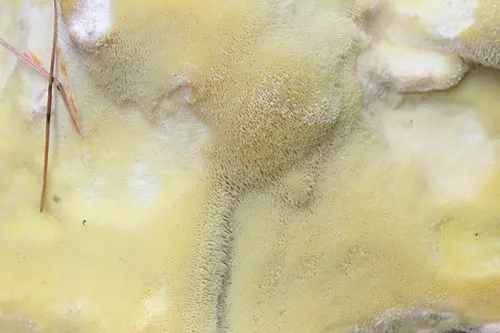
A large bracket fungus forming overlapping shelves of sulphur-yellow and orange on trees. Fresh fruit bodies are thick and fleshy with a yellow pore surface; old ones fade towards cream and become dry, brittle or chalky.
What to check
Confirm true pores rather than gills and record the pore colour, growth form, host tree and region. Laetiporus sulphureus typically forms stalkless shelves with yellow pores on broad-leaved wood. It causes brown cubical heart rot and may fruit from living trunks, dead standing trees, stumps or logs.
Variation
The orange upper surface and yellow edge are strongest in fresh growth. Age, sun and rain can leave brackets pale yellow, cream or almost white, while thick clustered shelves may merge into large rosettes. Very old material loses most useful colour and texture.
Lookalikes
North America has several Chicken of the Woods species. Laetiporus cincinnatus usually forms a basal rosette and has white pores. Laetiporus conifericola and Laetiporus huroniensis grow with conifers, while Laetiporus gilbertsonii occurs mainly in western North America on hardwoods. Giant Polypore, Meripilus giganteus, is duller and blackens when bruised. Host and geography help, but photographs alone may only justify Laetiporus species group.
Habitat and range
Parasitic and saprotrophic, producing brown heart rot in broad-leaved trees and continuing on dead wood. Oak is frequent, with beech, willow, poplar, chestnut, cherry and other hosts also recorded. Similar fungi called Chicken of the Woods elsewhere may belong to different regional Laetiporus species.
Food safety
Choice edible.
Use this profile to learn what to examine and compare, not as proof that a mushroom is safe to eat. Check the whole specimen and every important lookalike before reaching an identification.
Photographs
 Jo!Hannes / CC BY-SA 4.0
 I. Sáček, senior / CC0