

About this fungus
Clouded Funnel is a fungus in the Clitocybaceae family. Its habitat and field characteristics are summarised below.
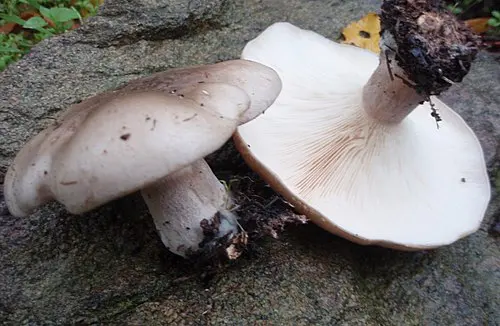
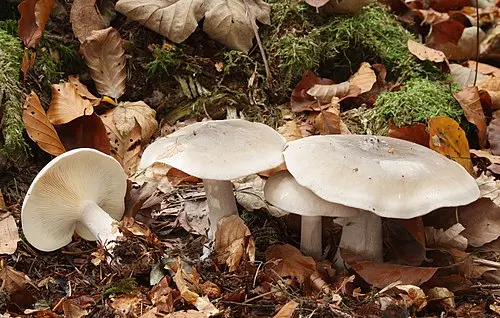
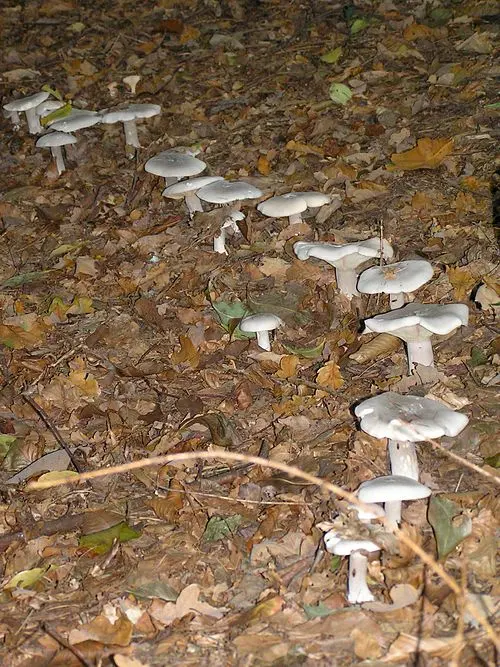
A chunky woodland mushroom that often appears in conspicuous troops or wide rings. Young caps are domed or sometimes bluntly conical, then flatten and may become shallow funnels. The surface is grey to brownish-grey, usually darker and clouded near the centre, and often carries a fine whitish bloom. Crowded pale gills, a stout whitish stem and a strong unusual smell complete the typical field impression.
What to check
Check the whole combination rather than cap colour alone. The crowded gills are creamy white and meet the stem broadly or run a short way down it. The stem is thick, has no ring, and is often swollen at the base with conspicuous white mycelium. A substantial print is creamy white to very pale buff, not pink. The flesh stays white when cut. Odour can be strongly unpleasant or coal-tar-like, but some collections smell sickly sweet, fruity or turnip-like, so smell is supporting evidence rather than a fixed test. Smooth, colourless, non-amyloid spores that often cling in small groups can confirm difficult collections under a microscope.
Variation
Caps range from pale grey to brownish-grey and can become very pale, especially at the margin or in whitish forms. The powdery or felt-like bloom is most obvious on young caps and may wear away. Caps broaden slowly, sometimes over several weeks, and old margins can become wavy while the centre develops a shallow depression. Stems may brown where handled. The gills remain cream rather than turning pink; the colour model's pink response is best explained by warm lighting, leaf litter and nearby stem tones, not a published gill stage.
Lookalikes
Livid Pinkgill, Entoloma sinuatum, is the most important European safety comparison. Its gills are notched rather than decurrent and change from yellowish-white to pink as the pink spores mature; the spores are angular under a microscope. It is poisonous and causes gastrointestinal illness. A young specimen can lack obvious pink, so a mature collection and spore print are much safer evidence than one cap. In North America, the large white Clitocybe robusta and related pale species can overlap in appearance and may require mature specimens and microscopy. Wood Blewit has lilac tones and ornamented spores, but faded examples should still be checked carefully. None of these comparisons makes cap colour alone dependable.
Habitat and range
Saprotrophic in leaf litter and humus under both broadleaf trees and conifers, and sometimes beneath hedges or in established shrubberies. It is particularly good at forming dense troops and large fairy rings, which may return in the same area. The European species concept is well established and widespread. Similar mushrooms are reported from North America, Japan, New Zealand and elsewhere, but mycologists have questioned whether all distant North American collections belong to exactly the same phylogenetic species. Old or declining Clouded Funnels sometimes host Piggyback Rosegill, Volvariella surrecta, a small pale parasite that fruits directly from their caps.
Food safety
Edibility is uncertain or disputed.
Photographs
 Horst74 / CC BY 3.0
 Horst74 / CC BY 3.0
 Holger Krisp / CC BY 3.0
 Daniel Ullrich (Threedots) / CC BY-SA 3.0