

About this fungus
Club Foot is a fungus in the Hygrophoraceae family. Its habitat and field characteristics are summarised below.
A grey-brown woodland funnel with pale gills and a stem that broadens into a conspicuous club-shaped base.
What to check
Look for a cap that becomes flat or shallowly funnel-shaped, broad pale gills running well down the stem, and a distinctly swollen stem base. There is no ring or volva. Confirm the whole combination because several woodland funnels have decurrent gills.
Variation
Caps range from buff and grey-brown to darker brown, usually paler at the margin. The clubbed base can be less obvious in slender or buried specimens.
Lookalikes
Infundibulicybe gibba has a more evenly tapering stem rather than a swollen base. Clitocybe nebularis is usually larger and more robust. Other pale funnels include toxic species, so the clubbed base is supporting evidence rather than a stand-alone guarantee.
Habitat and range
Saprotrophic on leaf and needle litter in broadleaf and conifer woodland, sometimes in groups. Regional accounts mention beech, spruce, fir and other trees, but the fungus is decomposing litter rather than partnering with one host.
Food safety
Inedible.
Photographs
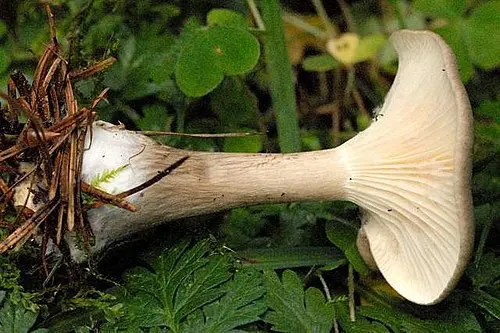 James K. Lindsey / CC BY-SA 3.0
Species to compare
Similar mushrooms to compare against: