
About this fungus
Clustered Domecap is a fungus in the Lyophyllaceae family. Its habitat and field characteristics are summarised below.
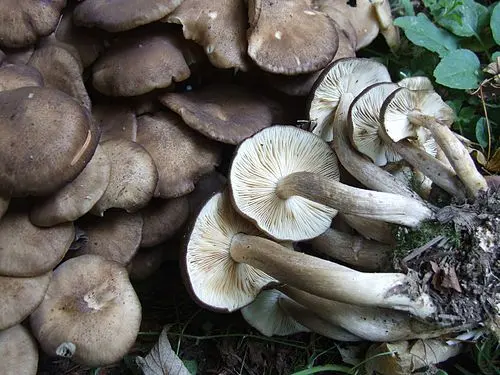
Sturdy grey-brown mushrooms in dense, congested clusters, often with several curved stems joined at the base on disturbed soil.
What to check
Confirm smooth moist but not slimy caps, crowded white to pale grey attached gills, firm white flesh, a pure white spore print and no ring or volva. The dense fused cluster is useful but not unique. Microscopy may be required within the Lyophyllum decastes species group.
Variation
Caps range from whitish and grey-brown to yellow-brown or dark brown, usually darker when young. Expanding caps may become lobed, wavy or upturned.
Lookalikes
Several species are included in or resemble the Lyophyllum decastes group. Lyophyllum loricatum has unusually tough cap skin, while Lyophyllum fumosum has a fibrous cap and mealy odour. Other clustered brown mushrooms may differ in spore print, gill attachment, ring or substrate.
Habitat and range
Saprotrophic on disturbed soil rich in buried organic matter, including path edges, landscaping, parks, roadsides and grassy woodland margins. It may fruit in very large clusters.
Food safety
Edible.
Use this profile to learn what to examine and compare, not as proof that a mushroom is safe to eat. Check the whole specimen and every important lookalike before reaching an identification.
Photographs
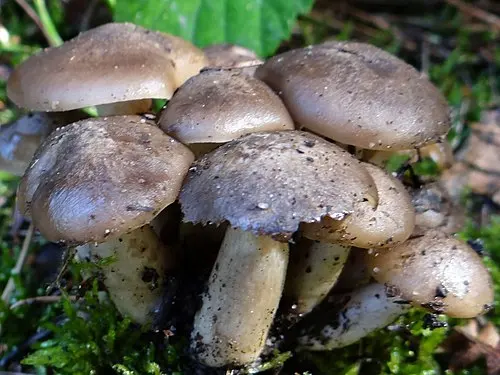 Jerzy Opioła / CC BY-SA 3.0
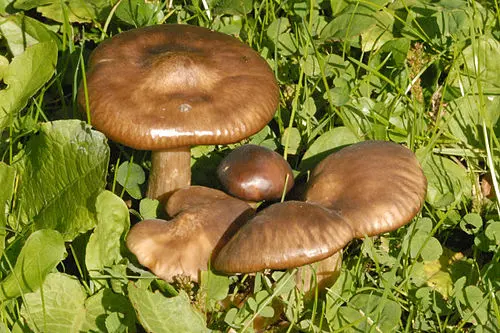 James Lindsey / CC BY-SA 3.0