

About this fungus
Clustered Toughshank Mushroom is a fungus in the Omphalotaceae family. Its habitat and field characteristics are summarised below.
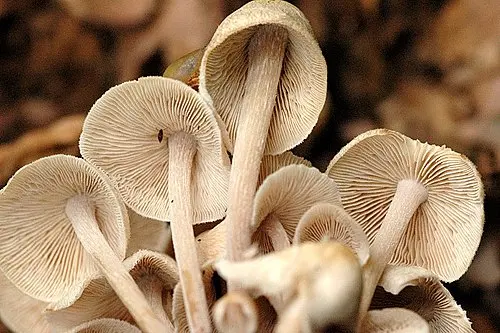
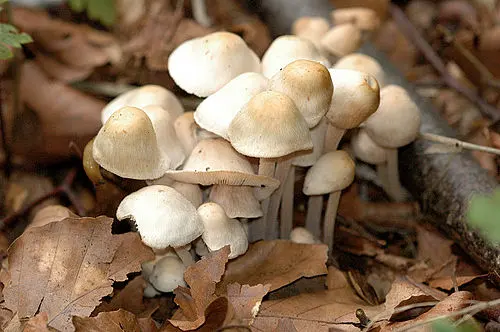
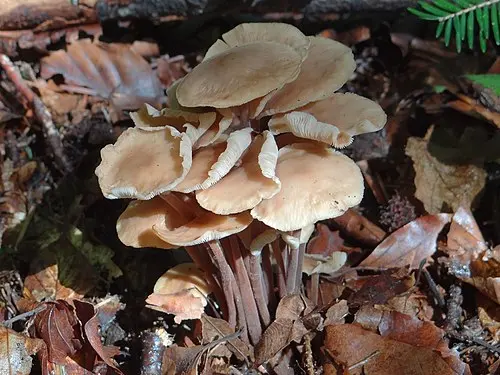
A slender woodland mushroom growing in tightly packed clusters, troops or rings. Moist caps are pinkish-brown to flesh-coloured and fade almost cream as they dry, while the long stems crowd and often join at the base.
What to check
Look for dense growth, crowded narrow cream gills, a white spore print and tough hollow stems covered in fine whitish hairs. The stems lack a ring and usually broaden slightly at the top, giving crowded clusters a bundled appearance.
Variation
The cap is strongly hygrophanous, so a moist brown-pink group can turn much paler as it dries. Mature caps may become wavy or irregular where they press against neighbouring mushrooms.
Lookalikes
Other small clustered Collybiopsis and Gymnopus species overlap. The Deceiver, Laccaria laccata, has thicker, more widely spaced gills and does not usually form the same densely confluent bundles. Microscopy may be needed for sparse or incomplete collections.
Habitat and range
Saprotrophic in deep leaf litter and humus in broad-leaved and mixed woodland, and occasionally conifer plantations, sometimes above buried dead wood. Molecular work shows that European and eastern North American populations traditionally given this name are not identical, so regional treatments matter.
Food safety
Edible.
Use this profile to learn what to examine and compare, not as proof that a mushroom is safe to eat. Check the whole specimen and every important lookalike before reaching an identification.
Photographs
 James Lindsey / CC BY-SA 3.0
 James Lindsey / CC BY-SA 3.0
 Jerzy Opioła / CC BY-SA 4.0