
About this fungus
Common Bird's-Nest is a fungus in the Agaricaceae family. Its habitat and field characteristics are summarised below.
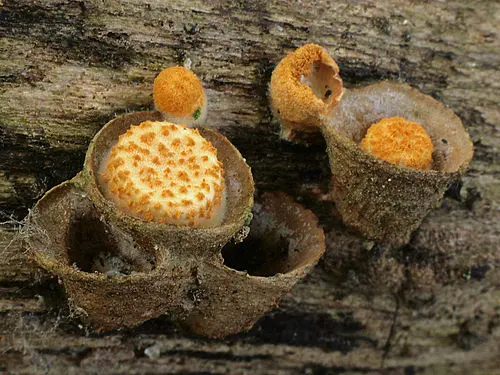
A tiny yellow-brown to cinnamon-brown cup that resembles a miniature bird's nest. Mature cups contain several pale, flattened spore packets like eggs and often occur in dense groups on small pieces of dead plant material.
What to check
Young fruit bodies are round or cushion-shaped and closed by a mustard yellow to yellow-orange papery lid. The lid disappears as the cup opens, revealing a smooth, shiny, whitish to grey inner wall and pale tan to buff peridioles. Fine cords attach the peridioles to the cup. The combination of a yellowish lid, smooth unribbed interior and attached cords is more useful than the bird's-nest shape alone.
Lookalikes
Cyathus striatus has a conspicuously shaggy outer wall and strongly fluted inner surface. Cyathus olla has a greyer outer surface, lacks the same yellow lid and often occurs on soil or dung-rich ground. Nidula species have freely lying peridioles without the same cord attachment. A hand lens is helpful because these differences occur at a scale of only a few millimetres.
Habitat and range
Saprotrophic on small fallen twigs, dead stems, nutshells, needles, woodchip, decaying vegetation and weathered manufactured wood. It is not usually a fungus of bare soil or large intact logs. The species is widespread in temperate parts of Europe, Asia and North America, with fruiting season varying by climate.
Food safety
Inedible.
Species to compare
Similar mushrooms to compare against: