

About this fungus
Common Bonnet is a fungus in the Mycenaceae family. Its habitat and field characteristics are summarised below.
A relatively large, tough-stemmed bonnet growing singly or in clusters from decaying wood. Its grey-brown cap is conical to bell-shaped when young, then broadens while usually retaining a central bump and conspicuous radial grooves.
What to check
Look for a smooth but grooved grey-brown cap, a cartilaginous stem that bends more readily than it snaps, and a woolly base that may root deeply into rotten wood. The gills are adnate to notched, sometimes with a short tooth, and often develop cross-veins and a pale pink flush with age. There is no ring or volva and the spore print is white.
Variation
Caps range from pale beige-grey to dark sepia-brown and fade toward a whitish margin. Young gills are white or grey, becoming pinkish in mature fruit bodies. The stem can be pale above and much darker below, while its rooting part may be hidden inside the wood.
Lookalikes
Mycena inclinata usually develops a rusty-brown lower stem with pale flakes. Mycena maculata often shows stronger reddish-brown spotting and has smaller spores. Other members of the Mycena galericulata group can be almost indistinguishable in the field, so microscopy may be needed when the cross-veins, rooting stem and growth form do not give a clear combination.
Habitat and range
Saprotrophic on well-decayed stumps, logs, branches and buried timber, mainly from broad-leaved trees such as beech, oak, birch and alder but occasionally from conifers. It is widespread across the northern hemisphere and may fruit from late spring through autumn, or longer in mild climates.
Food safety
Inedible.
Photographs
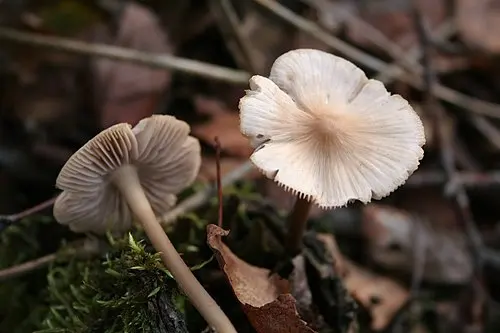 Strobilomyces / CC BY-SA 3.0
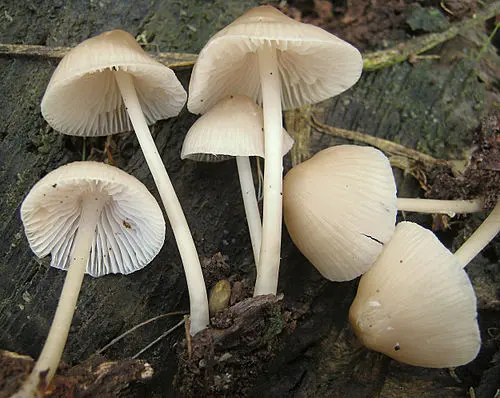 zaca / CC BY-SA 3.0
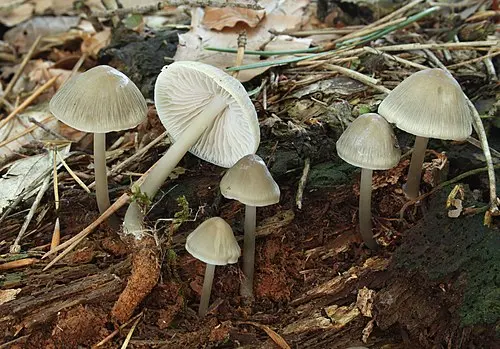 Holger Krisp / CC BY 3.0
Species to compare
Similar mushrooms to compare against: