

About this fungus
Common Earthball is a fungus in the Sclerodermataceae family. Its habitat and field characteristics are summarised below.
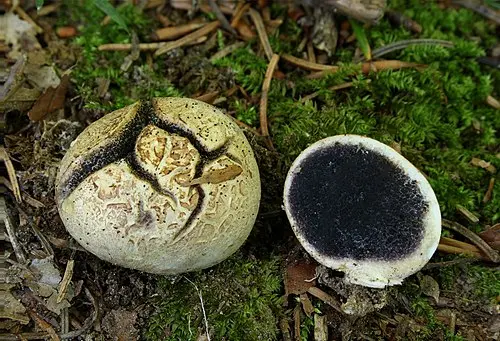
A tough, rounded or slightly flattened earthball that sits directly on the ground, attached by pale root-like mycelial cords. Its thick yellowish to ochre-brown skin breaks into coarse scales, often arranged around raised central warts. It feels firmer and more leathery than a typical true puffball.
What to check
Cutting one open reveals the enclosed spore mass, called the gleba, inside a thick pale rind. The gleba starts whitish and firm when extremely young, soon becomes marbled with pinkish or purple-brown tones, and matures to powdery purple-black or blackish brown. The outer scales often form small rosette patterns. Mature fruit bodies split irregularly at the top to release their spores. Round, strongly ornamented spores and the scale pattern help separate it from other earthballs under a microscope.
Variation
The outer surface ranges from cream or lemon-yellow through ochre to brown, and may stain pinkish or reddish when rubbed. Scale size and prominence vary, especially around the base. The interior changes far more dramatically, from pale and solid through white-veined violet-brown to a dry, dark powder. Smell is variable but can become strong, acrid or rubbery when the fruit body is cut or old.
Lookalikes
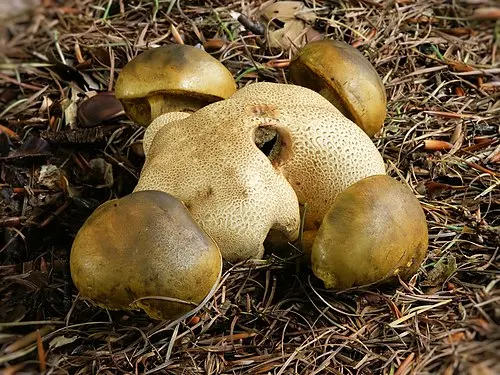
True puffballs usually have a thinner, softer skin and remain evenly white inside while immature, whereas an earthball soon develops a firm marbled or dark interior. However, the youngest Common Earthballs can also be pale inside, so white flesh alone does not prove that a puffball-like fungus is edible. A young Amanita can contain the outline of a developing cap, gills and stem when cut lengthways. Other Scleroderma species can be very similar and often need their surface pattern and microscopic spores checked. The Parasitic Bolete, Pseudoboletus parasiticus, sometimes grows directly from Common Earthball and can provide a useful supporting clue.
Habitat and range
An ectomycorrhizal species found with the roots of many broad-leaved and coniferous trees. It favours well-drained, often sandy, peaty or acidic soil in woods, woodland edges, heaths, parks, gardens and grass beneath trees. Fruit bodies occur singly or in groups, sometimes on or beside decaying wood. It is widespread across temperate regions of Europe, North America and Asia and has also been recorded farther afield.
Food safety
Poisonous.
Photographs
 Holger Krisp / CC BY 3.0
 Hans Hillewaert / CC BY-SA 4.0