

About this fungus
Common Puffball is a fungus in the Agaricaceae family. Its habitat and field characteristics are summarised below.
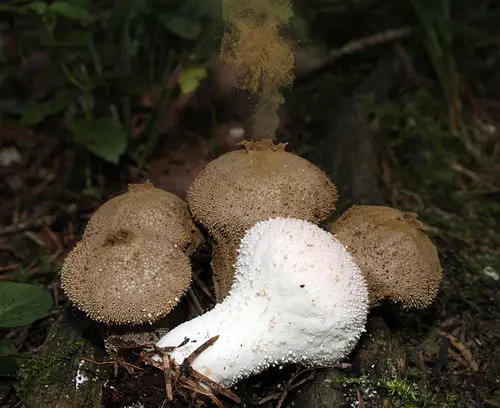
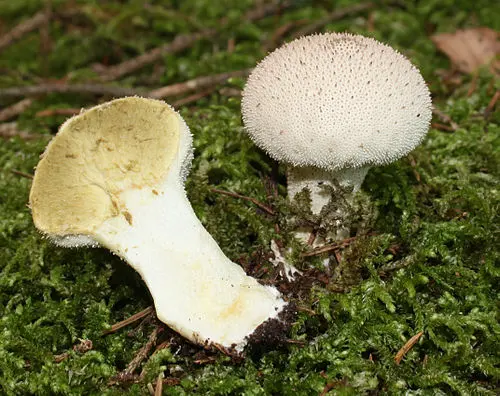
A pear-shaped puffball with a short sterile base and a surface studded with detachable cone-shaped spines. Fresh specimens are white to cream, becoming ochre and then brown as the spores mature.
What to check
Check for two sizes of surface warts, with the larger spines leaving a fine net-like pattern when they rub away. If considering food use, cut every specimen from top to bottom. The upper spore-bearing flesh must be firm and evenly white, with no cap, stem or gill outline. The lower sterile base can look chambered, but it must not contain a formed mushroom.
Variation
Spines are usually strongest on the rounded upper part and can disappear through age, rain or handling. The interior changes from white and firm to yellow, olive-brown and powdery, while an apical pore develops to release spores.
Lookalikes
An immature Amanita can look like a puffball from outside, but a vertical cut reveals the outline of a developing cap, stem and gills. Earthballs have a tougher rind and soon develop a dark or marbled interior. Stump Puffball usually grows in dense clusters from dead wood and has much finer surface granules.
Habitat and range
A widespread saprotroph on soil and litter in deciduous, coniferous and mixed woodland. It also occurs in grassland, pasture, heaths and dunes in temperate regions.
Food safety
Edible.
Use this profile to learn what to examine and compare, not as proof that a mushroom is safe to eat. Check the whole specimen and every important lookalike before reaching an identification.
Photographs
 H. Krisp / CC BY 3.0
 H. Krisp / CC BY 3.0