
About this fungus
Common Rustgill is a fungus in the Hymenogastraceae family. Its habitat and field characteristics are summarised below.
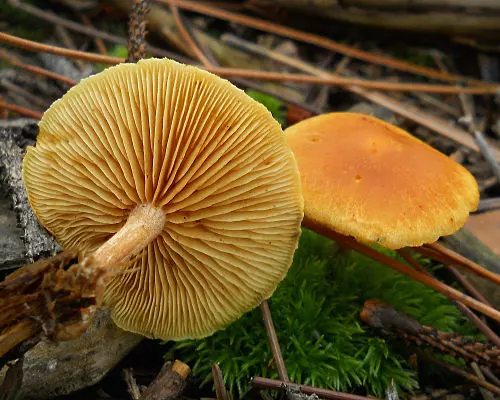
A small to medium orange-brown mushroom on conifer wood and woody debris, with yellow gills that soon acquire rusty spots. It may grow singly, in loose groups or in tufts, and its cap is normally smooth rather than coarsely scaly.
What to check
Look for a 4 to 8 cm silky-smooth or finely felted cap that is fiery orange-brown, tawny or golden and usually paler at the edge. The crowded gills are attached to the stem, starting yellow and becoming reddish-brown with rusty spots as the spores mature. The yellowish fibrous stem has no ring. The spore print is rusty orange-brown. Confirm that the mushroom is growing from conifer wood, cones, buried conifer debris or woodchip, while allowing for occasional hardwood records.
Variation
Caps vary from bright golden-orange to dull tawny-brown and can flatten or develop a shallow central depression with age. Gills may remain yellow on young mushrooms while older members of the same group are strongly rust-spotted. Fruit bodies can appear singly, in small groups or in crowded tufts.
Lookalikes
Gymnopilus sapineus is closely related and historically confused with this species; it usually has a more distinctly scaly cap, and difficult collections may require microscopy. Spectacular Rustgill, Gymnopilus junonius, is normally much larger and has a conspicuous stem ring, often on hardwood. Other small orange Gymnopilus species overlap in colour and substrate, so orange colour or rusty spores alone do not settle the species.
Habitat and range
Saprotrophic on rotting conifer stumps, logs, branches, cones, sawdust, buried woody debris and garden woodchip, with hardwood records much less frequent. It fruits from summer into late autumn across Europe and is also recorded in North America and other temperate regions.
Food safety
Inedible.
Photographs
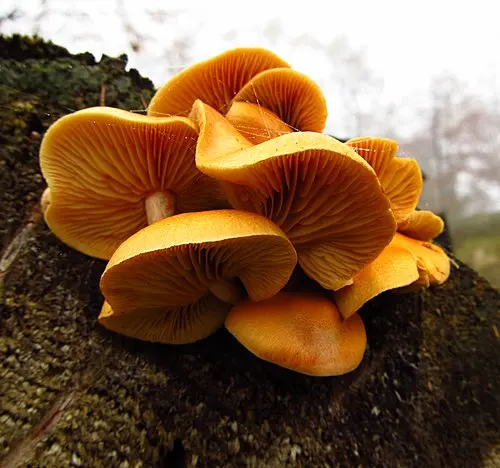 Hans-Martin Scheibner / CC BY-SA 3.0
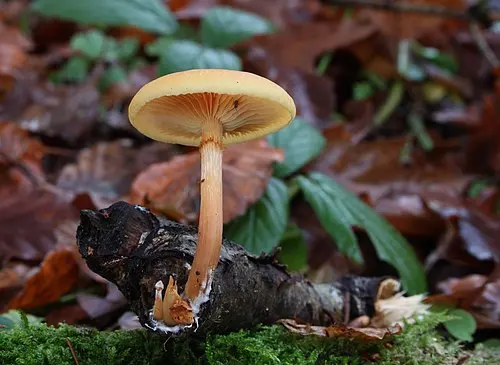 Holger Krisp / CC BY 3.0