
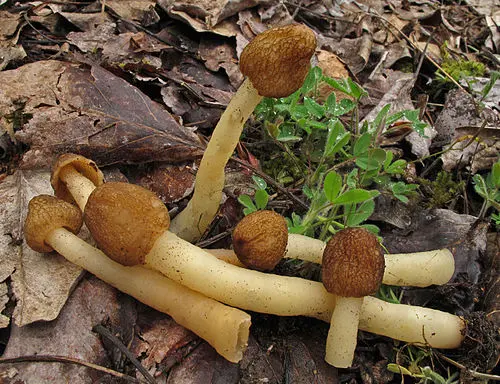
About this fungus
Conic Morel is a fungus in the Morchellaceae family. Its habitat and field characteristics are summarised below.
A fragile spring fungus that looks like a small brown thimble balanced on a long cream stem. The cap is joined only at the very top of the stem, leaving its lower edge hanging free like a skirt. It is a close relative of morels in the family Morchellaceae, but it is not a member of the true-morel genus Morchella.
What to check
Cut the fruit body lengthways and check the cap attachment first. In Conic Morel the stem reaches the crown and joins the cap only there; the rest of the cap hangs free. The outer cap surface bears the spores and is usually smooth, finely granular or gently wrinkled rather than divided into deep honeycomb pits. The cream to pale yellow stem is fragile and often contains soft cottony pith when young, becoming more hollow with age. There are no gills, ring or volva, and the spore deposit is pale orange. Attachment and internal structure are more dependable than colour alone.
Variation
Caps range from tan through olive-brown to dark brown and from a regular bell or thimble shape to irregularly folded in age. Wet caps may be tacky. Stems can be smooth or marked with pale brown fibres and bands, while their cottony filling can collapse as they mature. North American collections currently called Verpa conica may include at least two entities, and it is not yet clear that both are genetically identical to the European species on which the name is based.
Lookalikes
Wrinkled Thimble-cap, Verpa bohemica, is usually larger and has strong lengthwise folds and ribs; microscopy separates its two enormous spores per ascus from the eight smaller spores of Conic Morel. Half-free Morel, Morchella semilibera, has a genuinely pitted and ridged cap attached partway up its inner surface rather than only at the crown. Other true morels have honeycombed caps attached at least partly to the stem and a clean continuous hollow when cut. Gyromitra species have broader brain-like or saddle-shaped lobes and include seriously poisonous species. A very wrinkled Conic Morel cannot always be settled from a photograph alone.
Habitat and range
Fruits on soil and humus in spring, singly, scattered or in small groups. European records include hedgerows, scrub, deciduous or mixed woods, woodland edges, parks, gardens and river-valley grassland, often on base-rich or calcareous ground. North American records also include moist riverbanks, hardwood forest and some conifer sites. Modern isotope evidence supports a saprotrophic lifestyle, so nearby hawthorn, willow, cherry, alder, birch, cottonwood or pine should be treated as habitat context rather than a proven exclusive host partnership.
Food safety
Edibility is uncertain or disputed.
Photographs
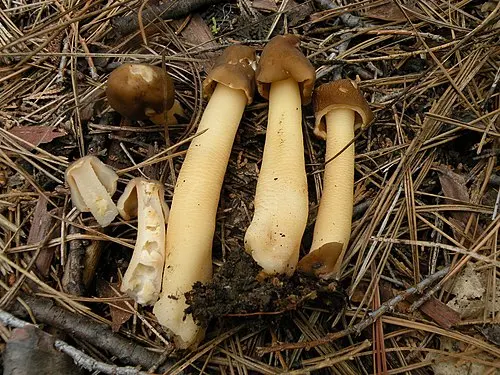 Jeff Riedenauer (Tamsenite) / CC BY-SA 3.0
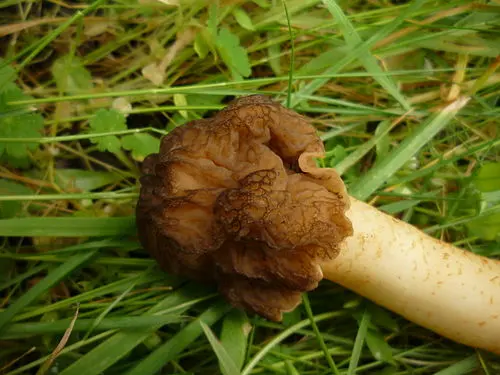 Byrain / CC BY-SA 3.0
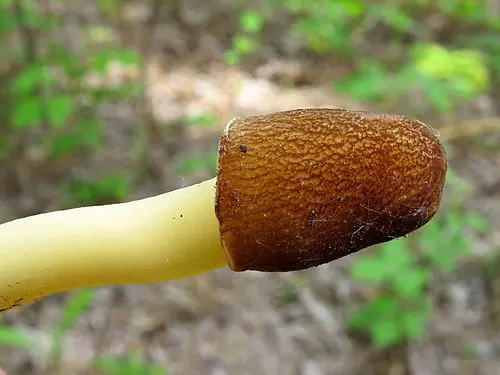 Аимаина хикари / CC0