
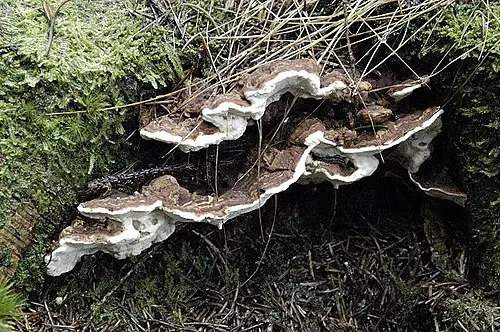
About this fungus
Conifer-base Polypore is a fungus in the Bondarzewiaceae family. Its habitat and field characteristics are summarised below.
An irregular perennial bracket or spreading crust at the base of a conifer, on exposed roots or inside a hollow stump. The upper surface is uneven and brown to nearly black, with a contrasting white or cream growing margin.
What to check
Look beneath for very fine cream pores that become ochre or brown with age. The fruit body is tough and woody, often low, partly hidden by litter and more crust-like than a neat shelf. Record the host tree and region because the Heterobasidion annosum complex cannot be resolved from cap colour alone.
Variation
Young margins are soft and white, while older upper surfaces become corrugated, darker and sometimes green with algae. Fruit bodies range from thin flat patches to overlapping knobbly brackets and may persist for several years.
Lookalikes
Heterobasidion parviporum and Heterobasidion abietinum are close European relatives associated especially with spruce and fir. Their fruit bodies overlap strongly and may require host, microscopy or DNA. Ganoderma brackets are usually thicker and release brown spores rather than the pale spores of Heterobasidion.
Habitat and range
A serious root and butt-rot pathogen. Heterobasidion annosum in the narrower European sense is associated especially with pine, while related members of the complex affect spruce, fir and other conifers. Infection can begin at fresh stumps and spread through root contacts before brackets appear near ground level.
Food safety
Inedible.
Photographs
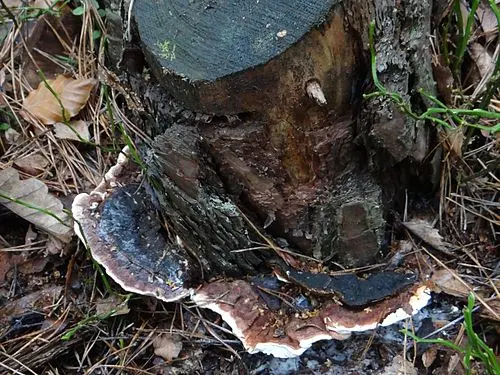 Jerzy Opioła / CC BY-SA 3.0
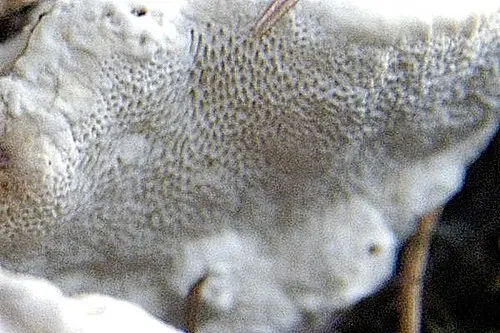 James Lindsey / CC BY-SA 3.0