
About this fungus
Conifer Mazegill is a fungus in the Gloeophyllaceae family. Its habitat and field characteristics are summarised below.
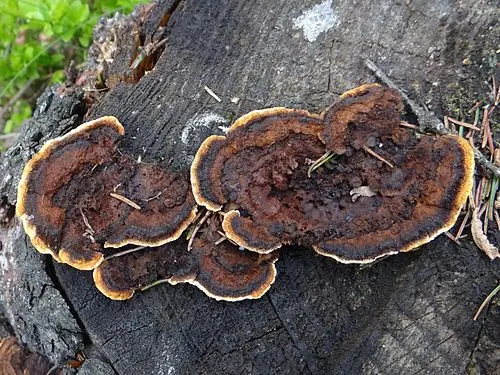
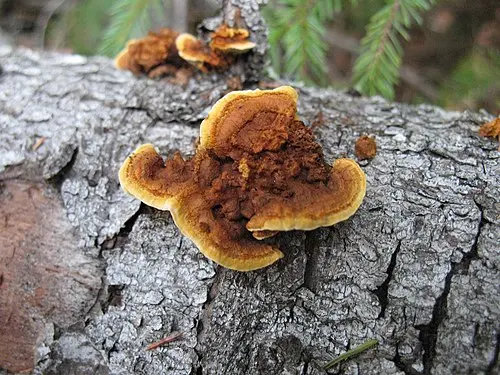
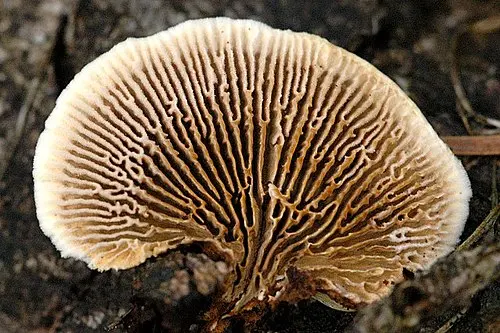
A tough, rusty brown bracket with a hairy zoned upper surface and a brighter yellow-orange growing margin. Underneath are thick, branching gill-like folds that merge into a maze.
What to check
Turn the bracket over and check for coarse radiating folds that fork and join, rather than thin true gills or a surface of round pores. The flesh is brown and corky, and the fungus grows directly from dead conifer wood without a normal stem, ring or volva.
Variation
Fresh margins are yellow-orange to rusty orange, while older attached areas darken to tobacco-brown or nearly black. The upper surface changes from velvety to rough and weathered. Underside folds can range from mostly gill-like to more maze-like.
Lookalikes
Gloeophyllum abietinum has coarser and more widely spaced folds. Trametes and Lenzites species cause white rot and usually differ in flesh colour and underside structure. Substrate, thick maze-like folds, brown flesh and brown cubical rot together are more useful than cap colour alone.
Habitat and range
Saprotrophic mainly on dead conifer trunks, stumps, slash, fence posts and other untreated softwood, with occasional records from hardwood. It causes brown cubical rot and is widespread in northern temperate and boreal regions.
Food safety
Inedible.
Photographs
 natureluvr01 / CC BY 2.0
 James Lindsey / CC BY-SA 3.0