
About this fungus
Crab Brittlegill is a fungus in the Russulaceae family. Its habitat and field characteristics are summarised below.
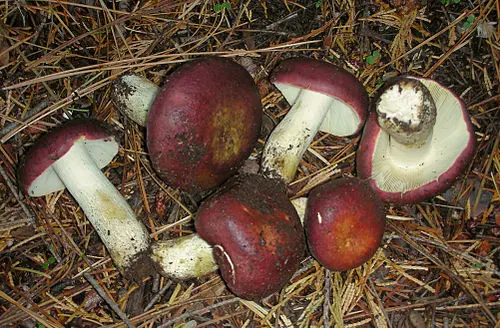
A substantial brittlegill with wine-red, purple or brownish cap tones, pale gills and flesh that develops brown staining. Older fruit bodies often develop a shellfish-like smell, but this points to a wider species group rather than proving the exact species.
What to check
Check for brittle flesh, cream to ochre gills and spore print, gradual browning where the stem or gills are handled, and a shellfish-like smell that often strengthens with age. A green reaction to iron salts supports subsection Xerampelinae. There is no ring or volva. Exact species identification commonly needs microscopy and DNA.
Variation
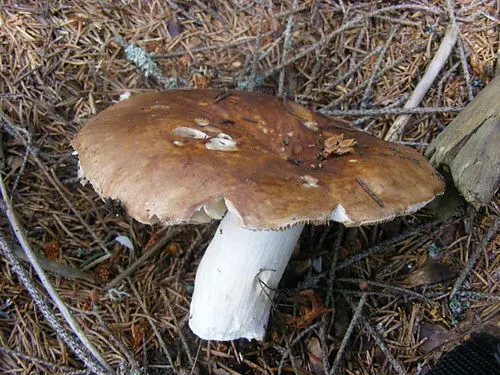
Cap colour varies widely through dull red, wine, purple, brown and mixed tones, sometimes on fruit bodies in the same group. The stem may be white or pink-flushed. Smell can be faint in young material, so its absence in one fresh mushroom does not exclude the wider group.
Lookalikes
Many members of Russula subsection Xerampelinae share the shellfish-like smell, browning and green iron-salt reaction. Modern work shows that several are regional species with overlapping field characters. In North America, mushrooms historically called Russula xerampelina normally belong to other taxa in the subsection.
Habitat and range
Ectomycorrhizal with coniferous and broadleaved trees. Russula xerampelina in the strict modern sense is Eurasian, while related shellfish-scented brittlegills occur in North America and other regions. The tree partner and region are important parts of the identification.
Food safety
Choice edible.
Use this profile to learn what to examine and compare, not as proof that a mushroom is safe to eat. Check the whole specimen and every important lookalike before reaching an identification.
Photographs
 Szabi237 / CC BY 3.0