
About this fungus
Crowded Russula is a fungus in the Russulaceae family. Its habitat and field characteristics are summarised below.
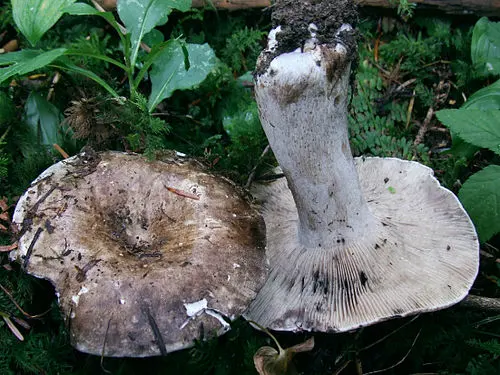
A solid, compact brittlegill that begins dirty white but slowly darkens through grey and brown to almost black. Its most useful visible feature is the mass of narrow, tightly packed gills beneath the cap, combined with a reddish phase before damaged flesh finally blackens.
What to check
Confirm brittle Russula flesh with no latex, a stout ringless stem and very dense narrow gills containing many shorter gills. Cut or broken flesh usually develops pink to reddish tones before becoming grey and then black, but the timing and strength vary and the full sequence may take several minutes. The gills begin white to cream or pale straw and also blacken when bruised. The spore print is white. Microscopic cap-surface characters may be needed for a firm species identification.
Variation
Young mushrooms may be almost entirely white, while older ones can be sooty grey-brown or black. A single fruit body often carries pale untouched areas, reddish recent damage and older black marks together. The reddish stage can be brief, slow or inconspicuous. Caps begin convex with an inrolled margin and become depressed or shallowly funnel-shaped as they mature.
Lookalikes
Russula nigricans has much thicker, widely spaced gills. R. anthracina tends to blacken without a clear red phase, while R. adusta usually has less crowded gills and can smell like an empty wine cask. European Compactae research confirms that microscopy may still be necessary. In East Asia, the fatally toxic R. North American records under the European name R. densifolia also require taxonomic caution.
Habitat and range
An ectomycorrhizal woodland mushroom associated with both conifers and broad-leaved trees. European accounts often place it on acidic soil in conifer forest, with less frequent broad-leaved records, but host emphasis and the exact species represented vary across its reported northern temperate range. It generally fruits from summer into autumn, with local timing set by climate.
Food safety
Inedible.
Photographs
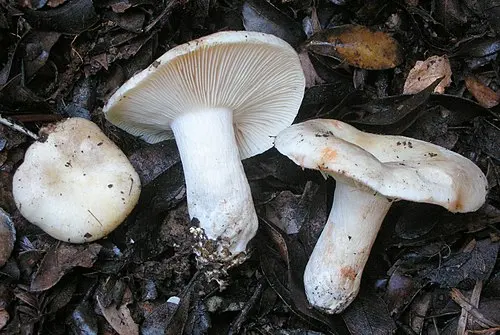 Ron Pastorino / CC BY-SA 3.0