

About this fungus
Crystal Brain Fungus is a fungus in the Hyaloriaceae family. Its habitat and field characteristics are summarised below.
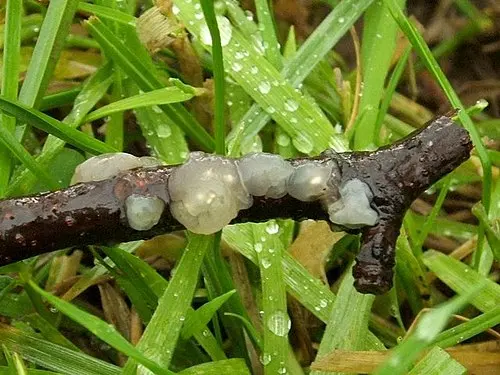
A soft, glassy white jelly fungus forming small pustules that merge into brain-like patches on dead branches.
What to check
Use a hand lens to look for distinct opaque white mineral granules embedded inside the otherwise translucent jelly. Fruit bodies dry to a thin varnish-like film and revive in wet weather. There are no gills, pores, ring or volva.
Variation
Colour ranges from nearly clear to milky white, sometimes yellowish, and old fruit bodies can become brown. Separate pustules commonly merge into patches several centimetres wide.
Lookalikes
White Brain Fungus is more opaque and firm and lacks the embedded granules. Several Myxarium species are macroscopically similar, and recent research indicates European and North American material historically grouped under this name may not all be the same species.
Habitat and range
Saprotrophic on dead attached and fallen broadleaf branches, often in damp shade and sometimes associated with old ascomycete fruit bodies. The name Exidia nucleata is an older synonym; modern sources retain Myxarium nucleatum but recognise a species complex.
Food safety
Inedible.
Photographs
 Lairich Rig / CC BY-SA 2.0