
About this fungus
Deadly Fibrecap is a fungus in the Inocybaceae family. Its habitat and field characteristics are summarised below.
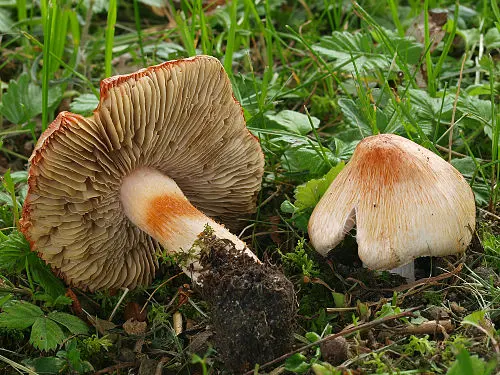
A sturdy fibrecap that begins pale cream or whitish and develops conspicuous pink-red to brick-red staining with age or damage. The dry cap has fine radial fibres and usually keeps a central bump as it expands. Its margin often splits, especially in dry conditions. Older mushrooms can become brownish-red overall.
What to check
Look across the whole fruit body for red staining, including the cap fibres, stem and bruised gills. The crowded gills begin whitish, then become pinkish-brown as the brown spores mature. Check for a fibrous cap with a persistent umbo and a bare stem with no ring or volva. Reddening is useful evidence, but it is not enough on its own to confirm the species.
Variation
Young specimens may be almost entirely white or pale yellow and show little staining until handled. Mature specimens can be streaked or extensively coloured red-brown, so mushrooms from the same group may look quite different. The gills also change from pale to brownish with age and can redden where damaged.
Lookalikes
Other pale fibrecaps can look very similar. Some do not redden as strongly, but weak staining on a young or dry specimen is not a safe way to rule this species out. St George's Mushroom is another pale spring species, but it has a smooth rather than radially fibrous cap, a white spore print and no red staining. Confident separation within the fibrecap group can require specialist keys and microscopic characters.
Habitat and range
A mycorrhizal species found on the ground with broadleaf trees, particularly beech and hornbeam, and also reported with other deciduous hosts. It is most associated with neutral or lime-rich soil and can occur in woodland, parks, gardens and grassy woodland edges. Fruiting time varies with local climate.
Food safety
Deadly poisonous. This species contains muscarine, which can cause vomiting, diarrhoea, heavy sweating, tears, salivation, visual disturbance and, in severe cases, breathing or circulatory problems. Symptoms usually begin quickly, often within 15 minutes to two hours. If ingestion is suspected, contact the local poison centre or emergency medical service immediately.
Photographs
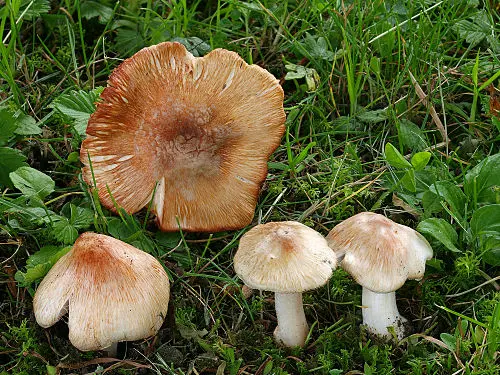 Andreas Kunze / CC BY-SA 3.0