
About this fungus
Deadly Webcap is a fungus in the Cortinariaceae family. Its habitat and field characteristics are summarised below.
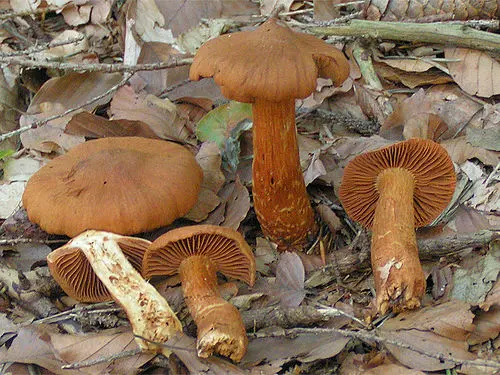
A slender rusty-orange to tawny-brown webcap of mossy northern woodland. The dry cap begins conical or convex and usually keeps a pointed or rounded central boss as it expands. Its fibrous stem is often paler than the cap and marked with irregular yellowish bands from the veil.
What to check
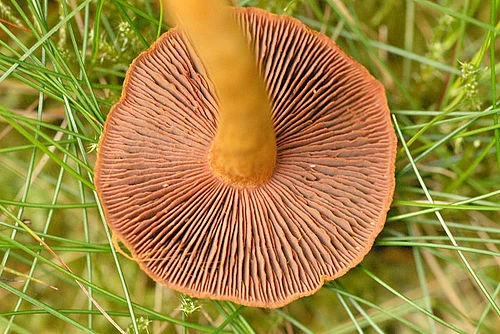
Young mushrooms have a fine cobweb-like cortina between the cap edge and stem. As it breaks, rusty spores catch on the fibres and leave a patchy zone rather than a solid ring. The fairly broad gills begin pale yellowish or orange-brown, then mature to rusty red-brown. The spore print is rusty brown, there is no volva, and the odour can be faintly radish-like.
Lookalikes
Deadly Webcap has entered chanterelle collections, sometimes because it fruits among Yellowfoot Chanterelles in the same moss. Chanterelles have blunt, branching ridges rather than separate true gills and do not have rusty cortina fibres. Even so, a crowded basket can hide individual specimens, so every mushroom should be checked separately. Fool's Webcap and several other brown-orange Cortinarius species can be very similar, and the presence or absence of orellanine cannot be judged from appearance alone.
Habitat and range
Ectomycorrhizal and most characteristic of damp, acidic, mossy spruce or pine woodland, including boggy ground and plantations. It also occurs in some mixed or deciduous woods with oak, beech or alder. Its range is centred on boreal and mountain regions of Europe, with records from parts of Asia and North America. Fruiting is mainly from late summer through autumn.
Food safety
Deadly poisonous. Orellanine selectively damages the kidneys, and as few as one to three fruiting bodies may cause severe renal failure. Symptoms are often delayed for several days and can occasionally take two to three weeks to appear. Thirst, headache, nausea, vomiting, abdominal or back pain and changes in urination may precede kidney failure. There is no established antidote. Dialysis may be needed, and irreversible damage can require a kidney transplant or prove fatal.
Photographs
 James Lindsey / CC BY-SA 3.0