
About this fungus
Deer Shield is a fungus in the Pluteaceae family. Its habitat and field characteristics are summarised below.
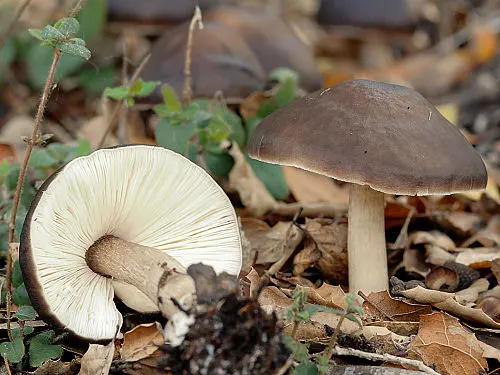
A medium to large wood-decaying mushroom with a smooth or finely streaked fawn to dark brown cap, crowded free gills and a pale stem marked with darker lengthwise fibres.
What to check
Confirm that the gills stop short of the stem and change from white to flesh-pink as the spores mature. The spore print is pink to salmon-pink. Check that the mushroom arises from dead or buried wood and that the stem has neither a ring nor a sac-like volva.
Variation
Caps range from pale fawn through grey-brown to dark brown and may be bell-shaped, convex or almost flat, sometimes with a low central bump. Colour and cap texture overlap strongly with other members of the cervinus group.
Lookalikes
This name belongs to a complex of very similar Pluteus species. In Europe, true Pluteus cervinus is widespread, but North American deer mushrooms may belong to P. exilis, P. elaphinus, P. hongoi or other regional taxa. Microscopic or DNA evidence may be needed for a species-level name. Entoloma species have attached rather than free gills and usually grow from soil.
Habitat and range
A saprotroph on stumps, logs, fallen branches, buried wood, sawdust and other wood waste, mainly from broadleaf trees but sometimes conifers. Buried timber can make a fruit body appear soil-borne.
Food safety
Edibility is uncertain or disputed.
Photographs
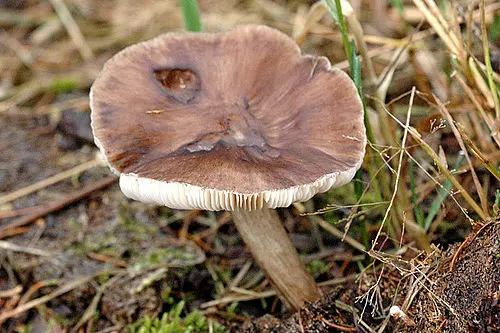 James Lindsey / CC BY-SA 3.0
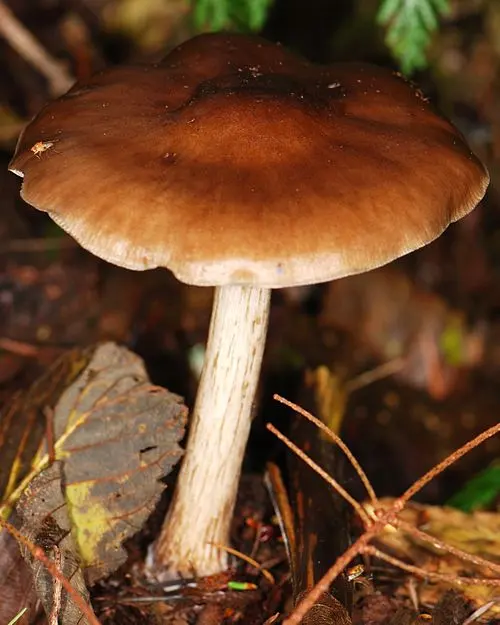 Madjack74 / CC BY-SA 3.0