
About this fungus
Destroying Angel is a fungus in the Amanitaceae family. Its habitat and field characteristics are summarised below.
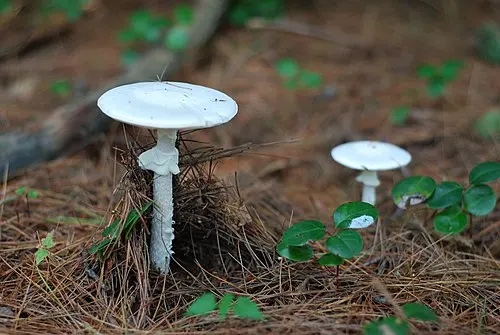
A slender white destroying angel of eastern North America. Its smooth cap opens from egg-shaped through convex to almost flat, above a white stem that is often fibrous or shaggy below the ring. The cap centre can age to cream or very pale tan, so the mushroom is not invariably pure white.
Identification features to check
Lift the whole stem base from the soil. A white membranous volva forms a loose sack around the rounded bulb, though it may be buried, torn or pressed against the stem. A thin white ring hangs on the upper stem and can also be damaged or lost. The crowded white gills are free or only just reach the stem, the spore print is white and the cap edge is not lined. A drop of five to ten percent KOH on the cap should turn it yellow, but confident separation from similar destroying angels also uses round spores and predominantly two-spored basidia under a microscope.
Variation
The cap is dry in fine weather and slightly sticky when wet. It can remain white or develop a faint cream, tan or pinkish centre in hot, dry conditions. The volva ranges from an obvious free cup to lobed tissue pressed against the bulb, while the delicate ring may collapse. Size varies considerably and is not a dependable way to separate this species from other destroying angels.
Lookalikes
Several eastern North American destroying angels are virtually identical in ordinary field characters, so many finds can honestly be identified only as Amanita section Phalloideae without chemical and microscopic work. White Dapperling has white free gills and a ring but no sack-like volva. White Agaricus species have no volva and their gills turn pink and then brown. Young Amanitas can resemble puffballs externally; a developing cap, gills and stem may be visible when one is cut open, but a uniform interior does not by itself establish that a puffball-like fungus is edible.
Habitat and range
Ectomycorrhizal and found on the ground in eastern North American woodland from Canada south into the United States and Mexico. It is frequent with oaks and other hardwoods, but it also occurs in mixed or coniferous forest. Fruiting is mainly from summer into autumn, either singly or scattered. Similar white destroying angels replace or overlap with it elsewhere in North America.
Food safety
Deadly poisonous. Its heat-stable amatoxins can destroy the liver, and cooking does not make the mushroom safe. There is usually a symptom-free delay of six to twelve hours before severe vomiting, abdominal pain and watery diarrhoea begin. A short period of apparent recovery may follow while liver injury continues; kidney dysfunction can also develop. Any suspected ingestion needs immediate emergency and poison-centre advice, even if the person feels well. Severe cases can require a liver transplant and may be fatal.
Photographs
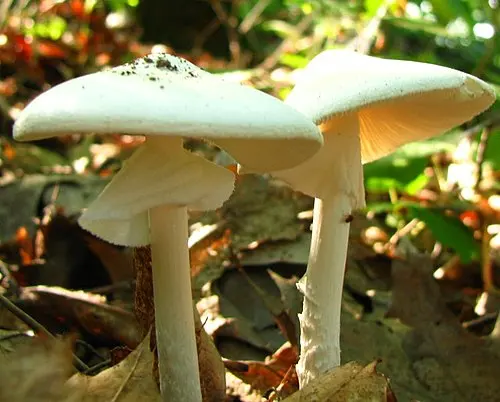 Dan Molter / CC BY-SA 3.0