

About this fungus
Destroying Angel is a fungus in the Amanitaceae family. Its habitat and field characteristics are summarised below.
A tall white Amanita with a slender, often shaggy-looking stem and a smooth cap that usually keeps a bell-like or irregularly conical outline as it expands. The centre of the cap can become creamy or faintly yellowish, so a perfectly pure white colour is not required.
What to check
Examine the whole mushroom, including the buried stem base. A broad white volva surrounds the swollen base like a loose sack, while a thin, fragile ring hangs higher on the stem and may collapse or disappear. The crowded white gills are free from the stem and the spore print is white. The cap edge is not lined. These characters identify a deadly white Amanita, but they do not by themselves prove the exact species.
Variation
Young mushrooms are enclosed by the universal veil and can look egg-shaped before the cap opens. The cap is slightly sticky when wet and shiny when dry, and it may carry a few veil fragments or none at all. The ring is easily damaged, the volva can remain hidden in the soil, and older mushrooms may develop an unpleasant smell or a creamy tint at the cap centre.
Lookalikes
Other white destroying angels can look almost identical. The European spring-fruiting Amanita verna and several white members of section Phalloideae may need microscopic or chemical work to separate. White Agaricus species lack a volva and their gills mature through pink to brown, while White Dapperling can share white gills and a ring but also lacks a volva. A young Amanita may resemble a puffball from outside; cutting it open can reveal the developing cap, gills and stem, but a uniform interior does not establish that any puffball-like fungus is safe to eat.
Habitat and range
A Eurasian ectomycorrhizal species of coniferous, deciduous and mixed woodland, usually on acidic, organic ground and often among moss. It is most characteristic of northern Europe and mountain districts farther south, with beech, birch and conifers among its reported partners. Fruiting is mainly in late summer and autumn. Older North American reports under this name generally refer to other destroying angel species.
Food safety
Deadly poisonous. Its amatoxins survive cooking and can cause severe liver failure after only a small amount is eaten. There is often no illness for six to twelve hours, followed by vomiting, abdominal pain and profuse diarrhoea. The symptoms may then ease even while liver injury is worsening; kidney failure can also develop. Suspected ingestion needs immediate emergency and poison-centre advice rather than waiting for symptoms. Severe cases may require a liver transplant and can be fatal.
Photographs
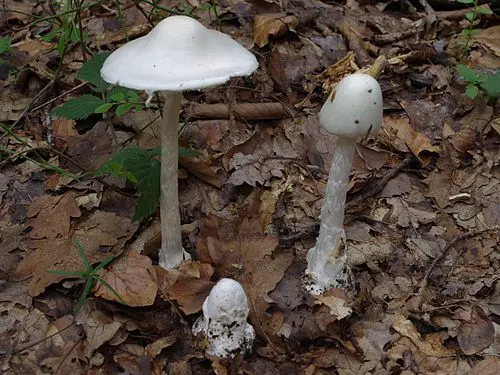 Jerzy Opioła / CC BY-SA 4.0
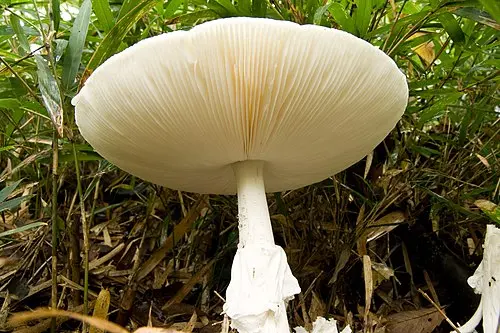 Σ64 / CC BY 3.0
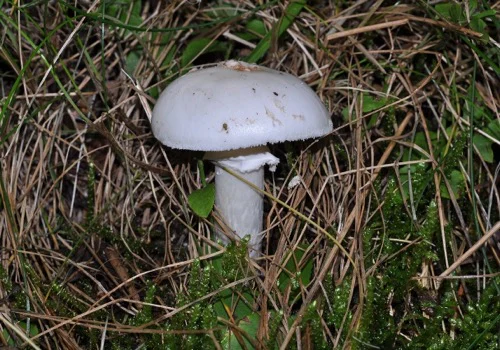 Quartl / CC BY-SA 3.0