
About this fungus
Devil's Bolete is a fungus in the Boletaceae family. Its habitat and field characteristics are summarised below.
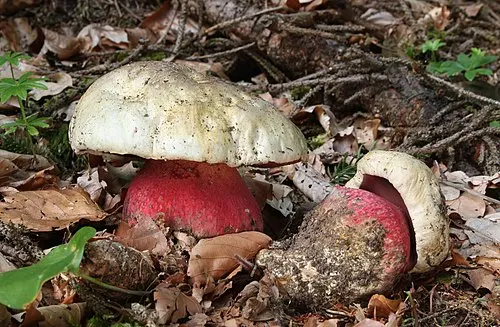
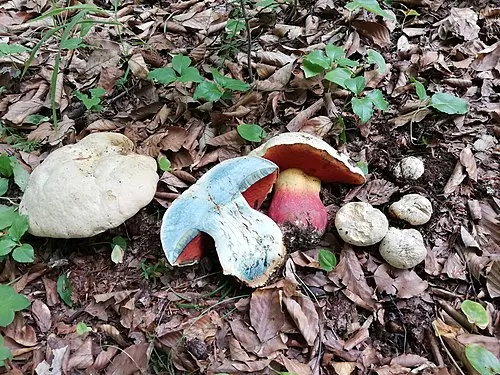
A very large, heavy bolete with a pale chalky or grey-buff cap above a striking red pore surface. The short stem is swollen or barrel shaped, yellow near the top and red below, with a fine red net over its surface. Mature specimens can develop an unpleasant putrid smell.
What to check
Turn the cap over and check the pore surface. Very young pores are yellow, then become orange and finally red or carmine. Pressure makes the pores turn blue. Cut flesh is pale yellow and usually develops a slower, less intense blue stain that can fade again. Also look for a very bulbous stem covered with a fine red network and an olive-brown spore print.
Variation
Young caps are velvety and almost white. They become smoother and may develop olive, buff, grey-brown or faint reddish tones with age and handling. Pore colour changes with maturity, so a young specimen may not yet have the dramatic red underside. The strength and speed of blue staining also vary between parts of the fruit body.
Lookalikes
Several European red-pored boletes are similar and some also cause poisoning. Lurid Bolete usually has a darker olive-brown cap and blues more rapidly. Bitter Beech Bolete has a pale cap but keeps yellow pores rather than developing red ones. Penny Bun has white then olive pores, a pale net on a lighter stem and no blue staining. North American mushrooms historically called Satan's Bolete are generally different species, so European comparisons should not be transferred without care.
Habitat and range
A warmth-loving mycorrhizal species of broadleaf trees, particularly oak, beech, lime and sweet chestnut. It fruits on the ground in open woodland, parks and wood pasture, usually where soil is rich in lime or chalk. True Rubroboletus satanas is principally European and should not be assumed from a similar North American bolete.
Food safety
Poisonous. Serious or fatal poisoning has been reported.
Photographs
 LukeEmski / CC BY-SA 3.0