

About this fungus
Devil's-fingers is a fungus in the Phallaceae family. Its habitat and field characteristics are summarised below.
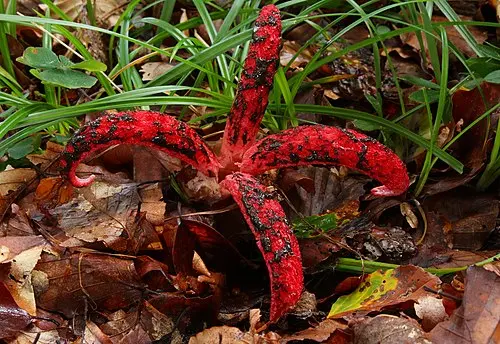
A distinctive stinkhorn that emerges from a whitish egg and unfolds several red finger-like arms coated with dark, foul-smelling spore slime.
What to check
Confirm four to eight separate red arms joined only near the base, dark olive-brown gleba on their upper surfaces, and whitish egg remains forming a volva-like cup below. Flies are often attracted to the carrion-like odour. There are no gills, pores or ring.
Variation
Arms range from vivid red to pink-red and their number varies. Young arms may remain upright before bending outward, while rain and insects remove much of the dark gleba from older fruit bodies.
Lookalikes
Clathrus ruber forms a red lattice rather than separate fingers. Aseroe rubra has a distinct stalk and central disc, while Pseudocolus fusiformis has fewer arms joined at their tips. Unopened stinkhorn eggs are not reliably identified from external appearance alone.
Habitat and range
Saprotrophic in leaf litter, wood chips, gardens and disturbed woodland soil. Native to Australia and nearby southern regions, it is now established in Europe and has appeared elsewhere through transported organic material.
Food safety
Inedible.
Photographs
 H. Krisp / CC BY 3.0
Species to compare
Similar mushrooms to compare against: