

About this fungus
Devil's Tooth is a fungus in the Bankeraceae family. Its habitat and field characteristics are summarised below.
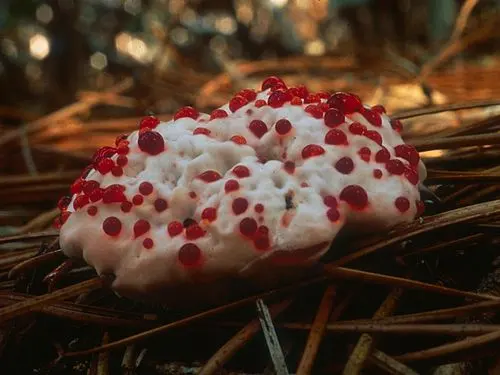
A tough, irregular tooth fungus whose young white to pink cap may carry striking blood-red droplets. The surface later becomes buff, brown and eventually very dark, so old fruit bodies can lose the feature behind its common names.
What to check
Look beneath for crowded short spines rather than gills or pores. They start pale and become pinkish-buff to brown as spores mature. Check the tough corky flesh, brown spore print and growth from soil with living conifers. Red guttation is helpful when present but is neither permanent nor unique to this species.
Variation
Moist, actively growing young caps show the clearest pale colour and red droplets. Drying, age and embedded litter can turn the cap pink-brown, buff, dark brown or nearly black, while adjacent fruit bodies may fuse into a lumpy mass.
Lookalikes
Mealy Tooth, Hydnellum ferrugineum, can also be pale when young and produce red droplets. It is associated especially with pine and has different flesh, spore and hyphal characters. Blue Tooth, Hydnellum caeruleum, may have a blue growing margin and blue over orange zoning in section. Mature or atypical Hydnellum often needs microscopy.
Habitat and range
Ectomycorrhizal with conifers, especially pine, on poor acidic or sandy woodland soil among moss and needle litter. Its range includes Europe, North America and parts of Asia, but abundance and conservation status vary greatly by region.
Food safety
Inedible.
Photographs
 Nathan Wilson (nathan) / CC BY-SA 3.0