
About this fungus
Dog Stinkhorn is a fungus in the Phallaceae family. Its habitat and field characteristics are summarised below.
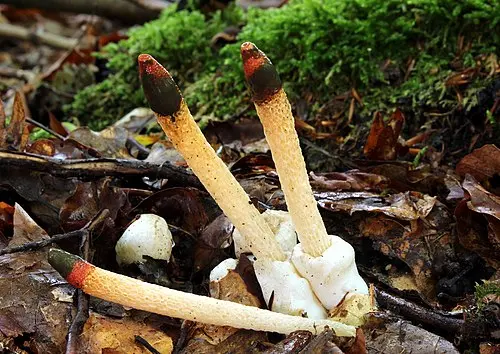
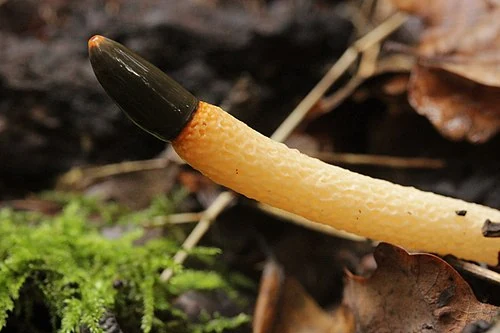
A slender stinkhorn emerging from a small white egg-like wrapper. The mature fruit body has a pale yellow to orange, hollow and spongy stem with a short orange-red tip. Fresh tips are partly covered by dark olive spore slime, which insects gradually remove.
What to check
Look for a narrow fertile tip that is clearly set off from the paler sterile stem, with dark olive gleba confined to the upper part. As insects remove the gleba, the orange-red surface beneath becomes visible. The stem is soft, hollow and foam-like, and white egg remains form a loose wrapper around its base. There is no ring.
Lookalikes
The Common Stinkhorn, Phallus impudicus, is larger and has a distinct bell-shaped head with a white honeycombed surface beneath its gleba. Mutinus ravenelii is generally more robust and pink to crimson. Mutinus elegans usually has stronger colour extending farther down the fruit body and is principally North American. Similar regional Mutinus species can require local keys, mature features and sometimes microscopy for a secure name.
Habitat and range
A saprotrophic fungus of decaying plant material, occurring among woodland litter and near rotting stumps as well as in woodchip mulch in parks and gardens. It fruits singly, in small groups or occasionally in rings. The strict species is chiefly European, with records in parts of Asia and uncommon reports from North America; similar slender stinkhorns should be checked with regional sources.
Food safety
Inedible.
Photographs
 Stu's Images / CC BY-SA 3.0
 Björn S... / CC BY-SA 2.0
Species to compare
Similar mushrooms to compare against: