

About this fungus
Dryad's Saddle is a fungus in the Polyporaceae family. Its habitat and field characteristics are summarised below.
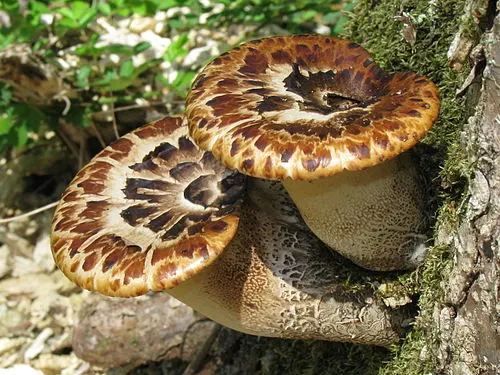
A large fan-shaped bracket on broadleaf trees, patterned with flattened dark brown scales arranged over a cream to ochre cap like a pheasant's back.
What to check
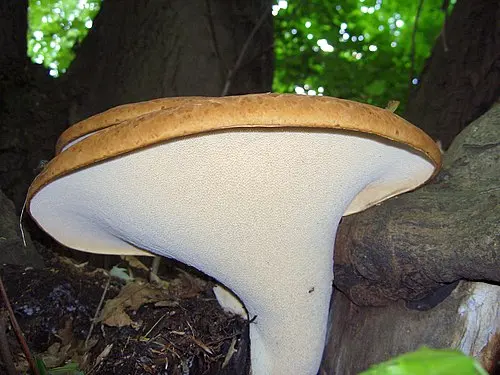
The underside has large angular pores, not gills, and the pore layer runs down a short off-centre stem that often darkens at the base. A cucumber or watermelon-rind odour can support the identification, but should not replace the visible characters.
Variation
Young brackets may be pale and only lightly marked. Mature caps show a much stronger concentric scale pattern, while old weathered fruitbodies become tougher and less sharply patterned.
Lookalikes
Birch Polypore has a smoother pale cap, smaller pores and grows on birch. Other large brackets usually lack the combination of flattened concentric scales, large decurrent pores and a short lateral stem.
Habitat and range
Parasitic on wounded living hardwoods and saprobic on dead trunks, stumps and logs. It causes white rot and occurs across much of Eurasia and North America.
Food safety
Edible.
Use this profile to learn what to examine and compare, not as proof that a mushroom is safe to eat. Check the whole specimen and every important lookalike before reaching an identification.
Photographs
 Dan Molter / CC BY-SA 3.0
 Mars 2002 / CC BY-SA 3.0