
About this fungus
Dune Stinkhorn is a fungus in the Phallaceae family. Its habitat and field characteristics are summarised below.
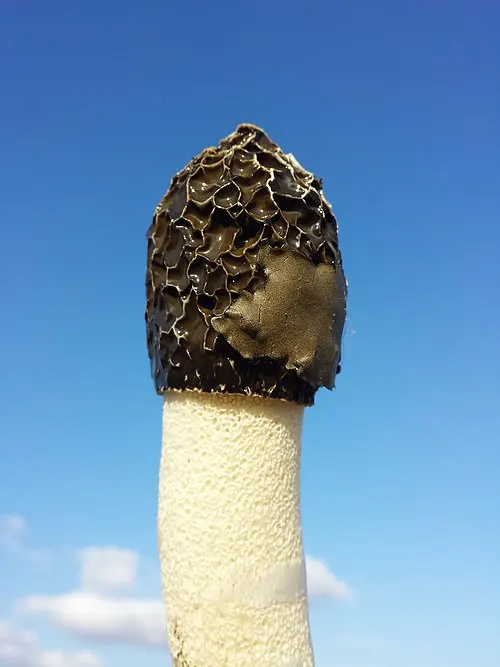
A stinkhorn that begins as a partly buried egg, then rapidly expands into a white spongy stem topped by a honeycombed head. Fresh heads carry dark olive, strongly scented spore slime that attracts insects.
What to check
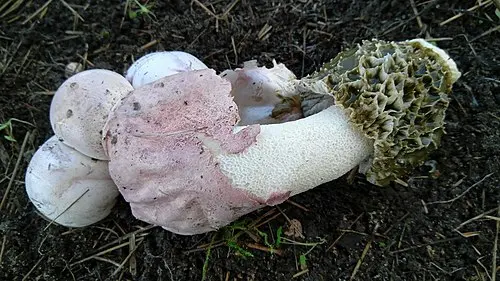
Expose the stem base and look for a pink to violet bag-like volva, the most useful field distinction from the Common Stinkhorn. The egg itself often has a pink or violet tint. Check the raised honeycomb pattern beneath the olive slime and the open sandy or disturbed habitat. The slime may already have been removed by flies.
Variation
The egg and volva can range from pale pink to a stronger violet. Insects may strip the gleba within hours, leaving a pale, much less scented honeycombed head. Weathered specimens therefore look very different from newly expanded ones.
Lookalikes
Common Stinkhorn, Phallus impudicus, is extremely similar when mature but normally has a white egg and volva. Other Phallus species outside Europe differ in the head, collar and volva. A mature head alone may not settle the identification, so the base and local species range matter.
Habitat and range
Saprotrophic in coastal dunes, other sandy ground and dry disturbed soils. It is not confined to Britain or to coasts: records extend across Europe, Asia, North America, Australia and New Zealand, with inland habitats documented in several regions.
Food safety
Inedible.
Photographs
 Avg39128 / CC BY-SA 4.0